Pick at Garden Patch Farms (series)

pickgardenfarms23-copyright2012-2014_15 copy2

Today more and more people are discovering the pleasures of eating seasonal, locally grown produce, and farmer’s markets are popping up all over the city and surrounding suburbs.  However, if you are seeking an even more holistic experience, and would like to meet the people who grow your food or simply want to experience the region’s terroir, take a short trip out of the city to Pick. at Garden Patch Farms!

pickgardenfarms22-copyright2012-2014_15 copy2

pickgardenfarms10-copyright2012-2014_15 copy2

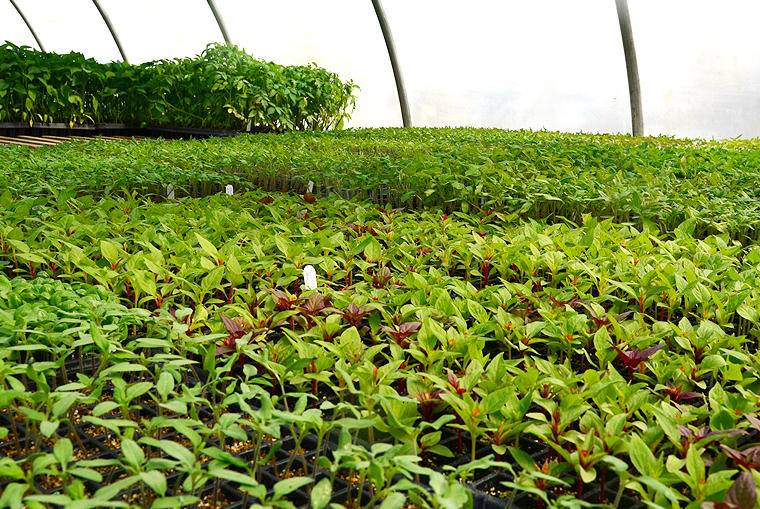
I was recently invited to Pick. at Garden Patch Farms to visit with Tony and Molly and tour the beautiful farm, so that I can experience and document the various stages of farm production, from seed to harvest! Molly gave me a detailed tour and explained the stages in preparation for the year’s harvest. They started out by sprouting seeds in their large green houses, which will later be transplanted outdoors, which takes place in the second or third week of May.

pickgardenfarms16-copyright2012-2014_15 copy2

pickgardenfarms3-copyright2012-2014_15 copy2

pickgardenfarms5-copyright2012-2014_15 copy3

pickgardenfarms24-copyright2012-2014_15 copy2

pickgardenfarms6-copyright2012-2014_15 copy2

Pick. At Garden Patch Farms is a farmer’s market situated on 30 gorgeous acres of prime farmland in Homer Glen, Illinois, just 40 minutes from downtown Chicago. The Hiller family has worked this land for nearly a century, and their wealth of experience in growing regional foods is apparent in the quality of everything they produce.

pickgardenfarms1-copyright2012-2014_

pickgardenfarms4-copyright2012-2014_15 copy2

pickgardenfarms8-copyright2012-2014_15 copy2

pickgardenfarms9-copyright2012-2014_15 copy2

pickgardenfarms27-copyright2012-2014_15 copy2

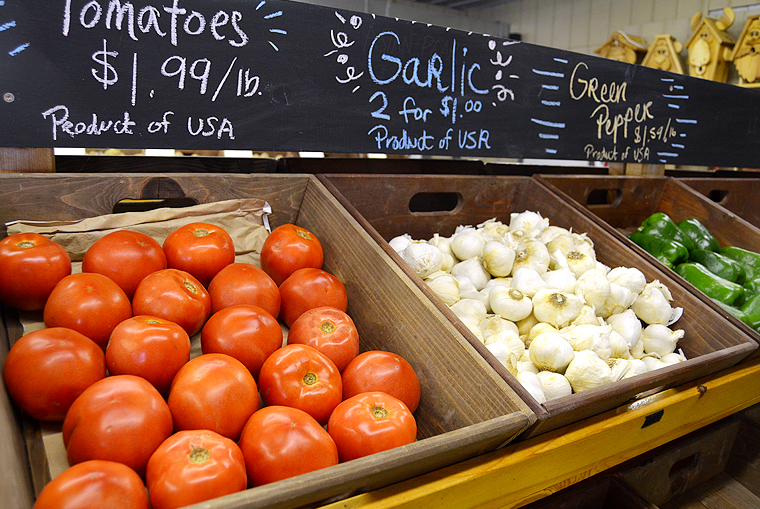
While some guests like simply to browse the extensive farm market, many demand absolute freshness and like to harvest their own fruits and vegetables. For $5 per visit, or $25 for a yearly pass, you can pick your own produce as fresh as you can get, while eating seasonally, supporting a local farming tradition, and even getting to know your grower! This is the definition of whole food.

pickgardenfarms14-copyright2012-2014_15 copy2

pickgardenfarms25-copyright2012-2014_15 copy2

pickgardenfarms13-copyright2012-2014_15 copy2

pickgardenfarms12-copyright2012-2014_15 copy2

pickgardenfarms7-copyright2012-2014_15 copy2

For the next several months, I will take my readers along on a tour of Pick. at Garden Patch Farms to document all the stages of growth on the way to harvest, and will include recipes prepared with fresh produce from Pick. Be sure to check back regularly throughout the growing season for updates, recipes, and of course lots of photos!

pickgardenfarms17-copyright2012-2014_15 copy2

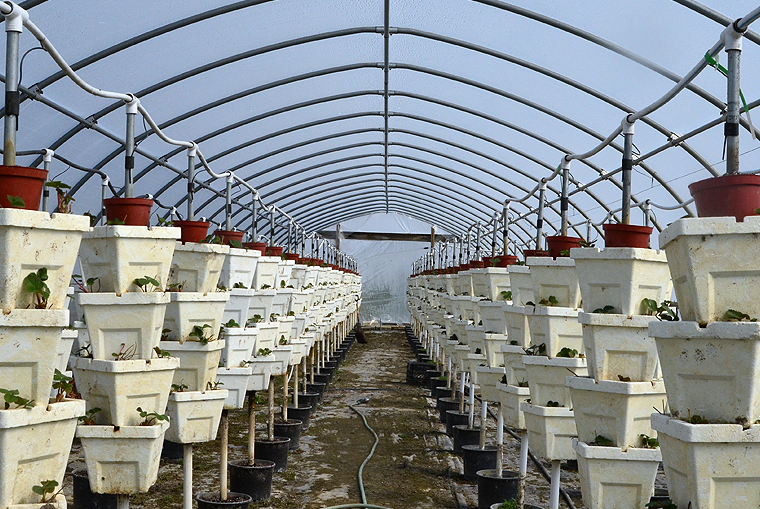
I love the unique system Pick. has setup to grow strawberries. The water flows throughout the pots down into bottom black planters that hold radishes

pickgardenfarms15-copyright2012-2014_15 copy2

Sprouted strawberry plant

pickgardenfarms2-copyright2012-2014_15 copy2

pickgardenfarms18-copyright2012-2014_15 copy2

pickgardenfarms21-copyright2012-2014_15 copy2

pickgardenfarms28-copyright2012-2014_15 copy2

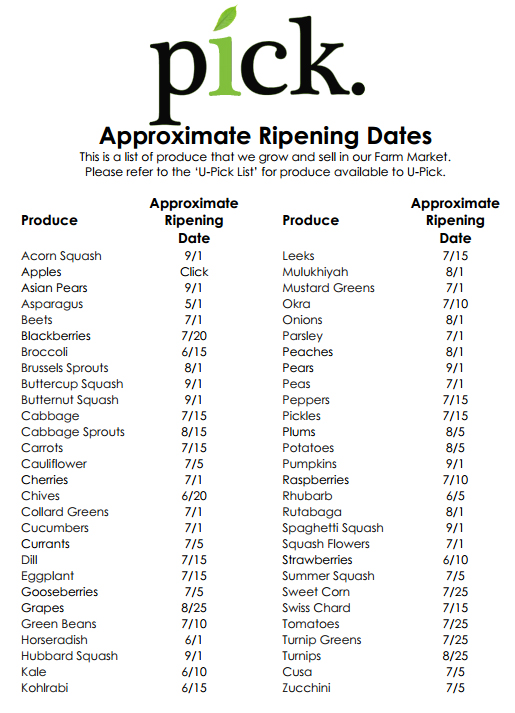
Below is list of the seasonal produce and when they are available at Pick. at Garden Patch Farms.

pickgardenfarms24-copyright2012-2014_

Pick. at Garden Patch Farms
14158 W. 159th Street, Homer Glen, IL 60491
(708) 301-7720
info@gardenpatchfarms.com

Our life as we knew it

blueberrypies5-copyright2012-2014_

I’ve been thinking a lot lately about our past life in Germany, where I began writing this blog. I’ve always loved cooking, trying out new and challenging recipes, but while living abroad in Europe I fell in love with food culture, especially European cuisine. I taught myself to cook through trial and error in a tiny kitchen that wasn’t much larger than a closet here in the states, with a magazine or book propped up on a large pot as I translated recipes from French, German, and Italian, making them over and over until they were perfect. Whatever challenge I was facing, the kitchen was my canvas, and food was my paint.

blueberrypies4-copyright2012-2014_

I miss my little kitchen, I miss our German home, and I miss the life we had there. For those of you who have lived abroad, you know what I’m feeling. I went through phases of alternately loving and hating it there, but somehow I end up missing even the little things. There was a pickle factory a few blocks away and the aroma of vinegar was always in the air, we lived at the foot of a hillside vineyard and all summer long we battled fruitflies and bugs, and each may the smell of rain mixed with manure spread on the vineyards; a not completely unpleasant scent, once you get accustomed to it. Life was simple, I rode my bike to the village market twice a week to buy eggs, bread, cheese, and vegetables from the farmers who grew them, each of them becoming familiar faces, some of them eventually friends. I miss all of them, even the cranky old potato guy.

blueberrypies1-copyright2012-2014_

blueberrypies3-copyright2012-2014_

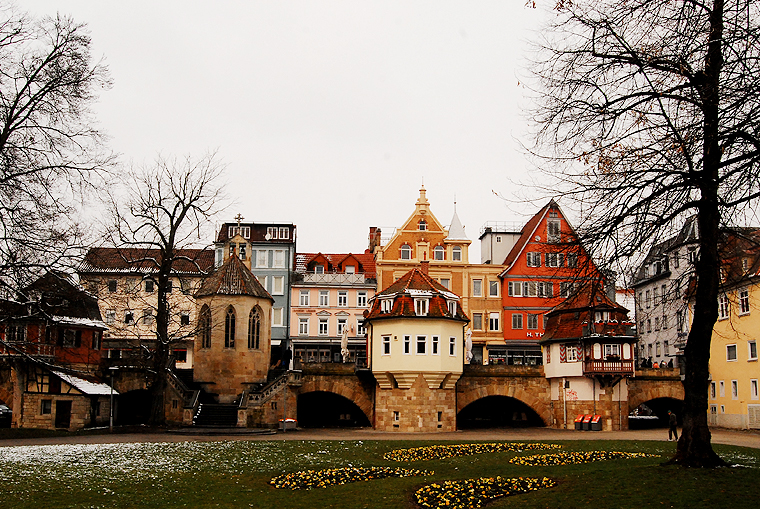
My husband and I used to meet at a park bench next to the river in the middle of town, for a lunch of sandwiches and chips, watching the growing line of customers line up at a medieval guard tower that today houses an ice cream shop. We used to refer to it as the ‘ice cream tower’, and I miss the sight of it, looming over the park. Besides work and meeting socially with friends, life was just that simple. No hustle and bustle of city life, just the two of us with our two cats in an isolation that was at first frightening but grew to be comforting in its simplicity. We learned to slow down and savor, to truly enjoy food, life, and each other. Small quarrels that seemed so big when we lived in Chicago, became insignificant once we had no choice but to instantly work them out.

blueberrypies2-copyright2012-2014_

blueberrypies6-copyright2012-2014_

One year ago today, we boarded a one-way flight back to Chicago with nothing but two suitcases and two pet carriers and ended our 4 years of living in Esslingen. Not a single day has passed when we haven’t spoken about Germany, and the great friends we made there. We find it difficult to stay in regular contact, to be honest, it is a little painful to face every day.

Today, one year later, Germany still feels like home, in our hearts, and we will always wonder when we will go back…

Friday Cocktail Hour with Aviation Gin

aviationgin1_copyright2012-2014

Those who know me know that I enjoy a cocktail every now and then, regardless of the weather or season. Whether I’m mixing up margaritas with friends and family or just stirring up martinis at home with my husband while watching movies, cocktails aren’t just for parties or special occasions. In the depths of a Midwestern deep-freeze, if you are suffering the winter blues like I am, a classic French cocktail might be just the thing to add a twist of sunshine to an otherwise gloomy winter day.

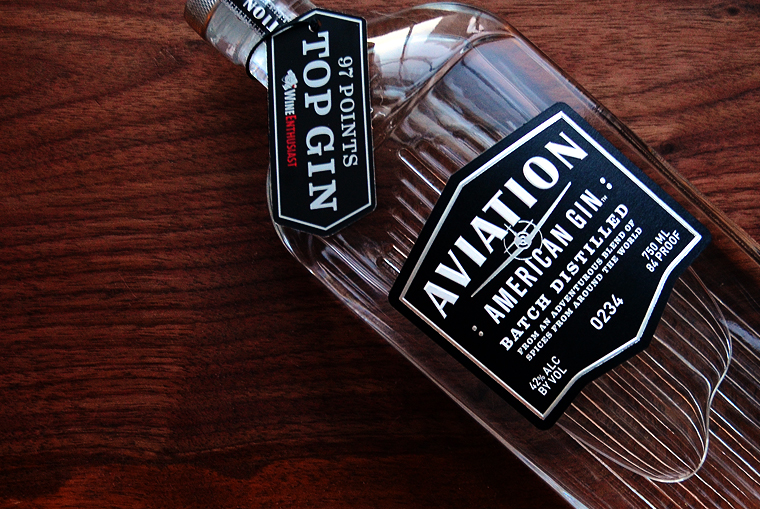
I should note that I’ve never enjoyed Gin; we’ve tried to make friends numerous times but somehow I can never manage to acquire a taste for it. I would always take a few sips then slide my glass to my husband to finish the rest. There was some flavor that overwhelmed whatever it was mixed with, a flavor I don’t much care for. Recently I tried an American style Gin, one that is not dominated by juniper but does not lack flavor. Aviation Gin, produced in Oregon, has notes of lavender, cardamom, and sarsaparilla, which tastes familiar as Gin but with a whole new freshness! After tasting a few Aviation cocktails last fall, and experimenting with a few classic cocktail recipes at home, I’ve realized that I do like Gin. Very much in fact.

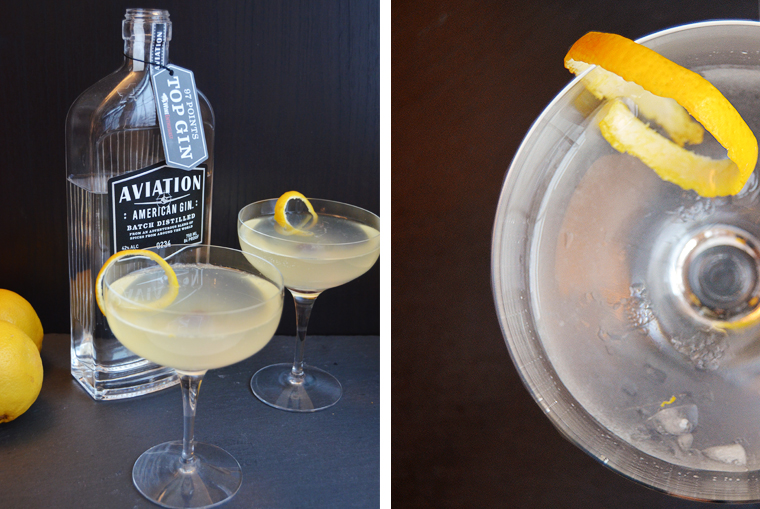
The French 75 

aviationgin2_copyright2012-2014

aviationgin7_copyright2012-2014

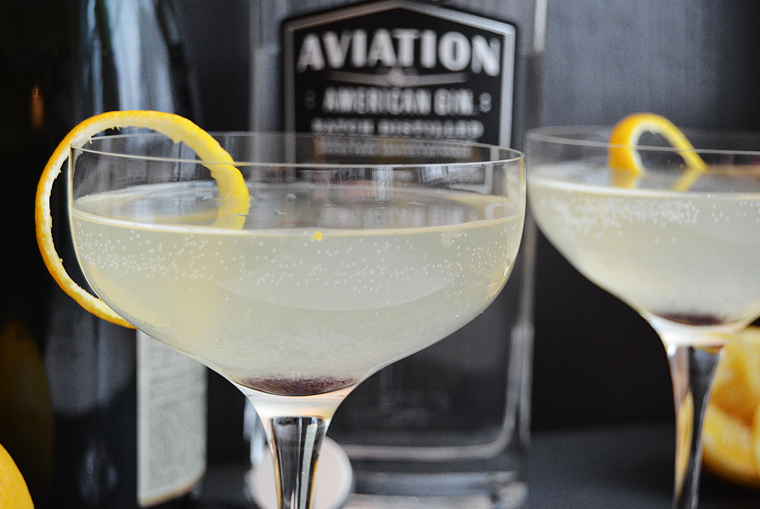
A favorite of Ernest Hemingway, the French 75 was created in 1915 at the New York bar in Paris—later known as Harry’s New York Bar—by Scottish barman Harry MacElhone. The combination was said to have such a kick that it felt like being shelled with the powerful French 75mm field gun, also called a “75 Cocktail”, or “Soixante Quinze” in French. The French 75 was popularized in America at the Stork Club in New York; I find this cocktail very elegantly potent.

Though Champagne is traditionally used, you can substitute just about any good sparkling wine for this cocktail. And who doesn’t love Champagne?! In Europe, Champagne is not only used to celebrate, you will often see people enjoying a glass at bistros as an aperitif before breakfast. The bubbles not only loosen you up but also cleanse the palate and awaken the taste buds. This would be a great morning cocktail, with it’s citrus-sweet taste.

There are variations to this cocktail including the use of cognac in lieu of gin; some pouring it over ice in a Collins glass while others prefer it from champagne flute. I prefer mine non-diluted in period-correct glassware. Either way, this simple, beautiful, refreshing cocktail is perfect any time of day, and is it’s own special occasion served in a glass.

aviationgin3_copyright2012-2014

French 75
recipe courtesy of Aviation Gin

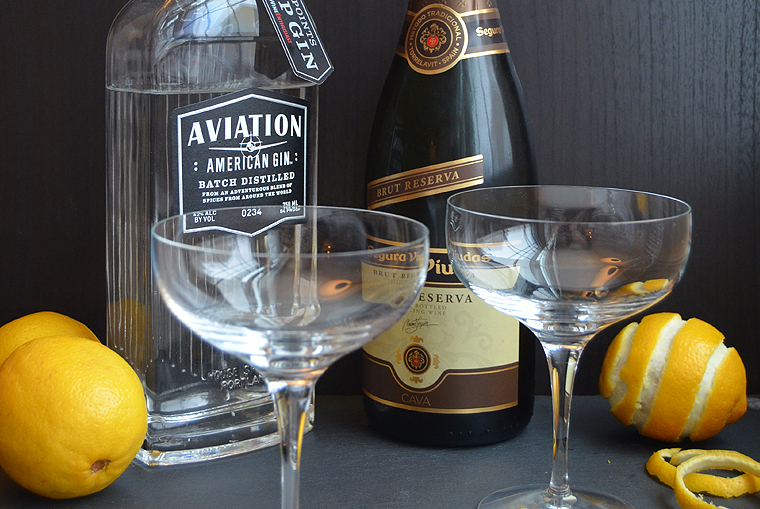
1 oz. Aviation Gin
1 oz. freshly pressed lemon juice
3/4 oz. simple syrup
3 oz. Brut Champagne
Cherries (fresh or dried)

In a pint glass or shaker, add the gin, lemon juice, and simple syrup. Shake vigorously. Add Champagne and strain into a chilled cocktail glass (I used antique 1920’s French Champagne glasses) and garnish with a lemon twist and a cherry.

Note: You can buy simple syrup, but it’s very easy to make your own. Put equal parts sugar and water into a small pot, bring to a boil, and stir until the sugar is dissolved. Let it cool and come to room temperature before using in cocktails.

aviationgin4_copyright2012-2014

aviationgin5_copyright2012-2014


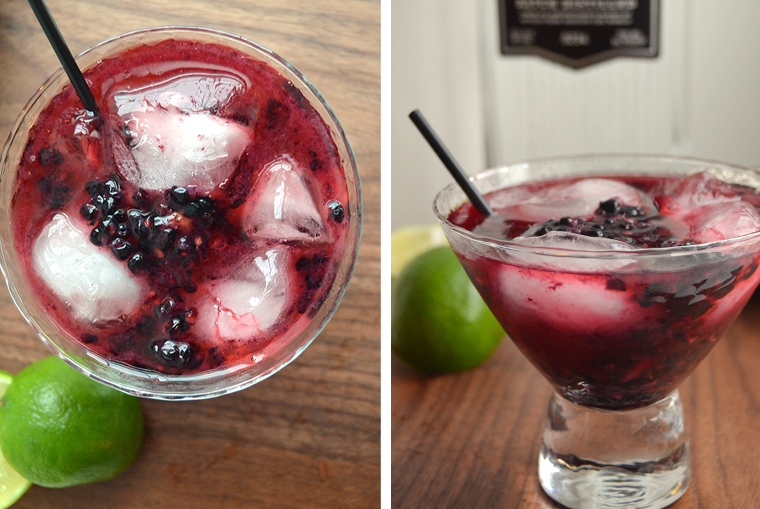
Muddled Blackberry Gimlet

aviationgin6_copyright2012-2014

If you are struggling with this blisteringly cold winter and wish spring would hurry up and get here already, this may be the cocktail for you!  Begin this ruby-colored cocktail by muddling blackberries, then mix in some ice cold Gin and a squeeze of lime juice. Blackberries have a nice, tart-sweet balance and add a jam-like flavor to cocktails.

aviationgin8_copyright2012-2014

Muddled Blackberry Gimlet
recipe courtesy of Aviation Gin

7 blackberries – muddled
2 oz. Aviation Gin
3/4 oz. freshly pressed lime juice
3/4 oz. simple syrup

In a pint glass or shaker, muddle the blackberries. Add the gin, lime juice, and simple syrup. Fill with ice and shake vigorously. Strain into a chilled cocktail glass. Garnish with blackberries and lime wedge.

aviationgin9_copyright2012-2014

aviationgin10_copyright2012-2014

References
http://en.wikipedia.org/wiki/French_75_(cocktail)


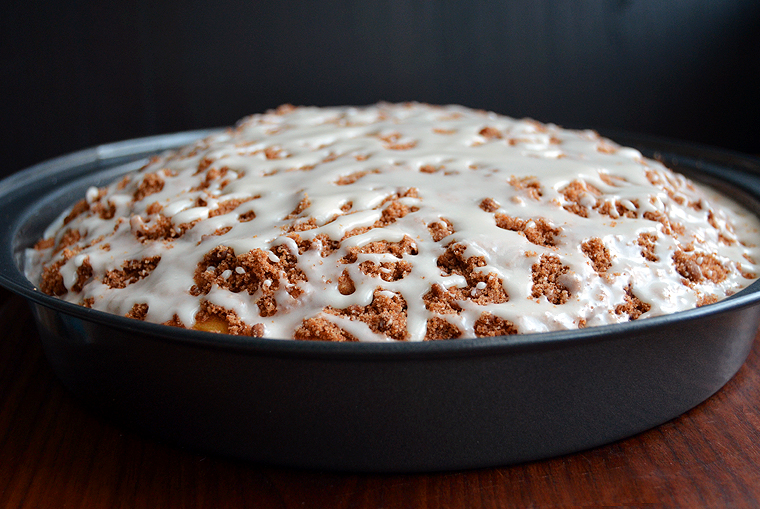
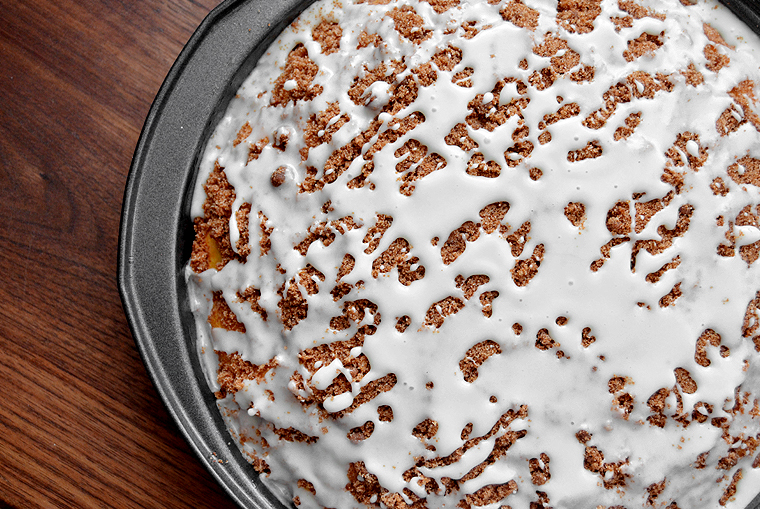
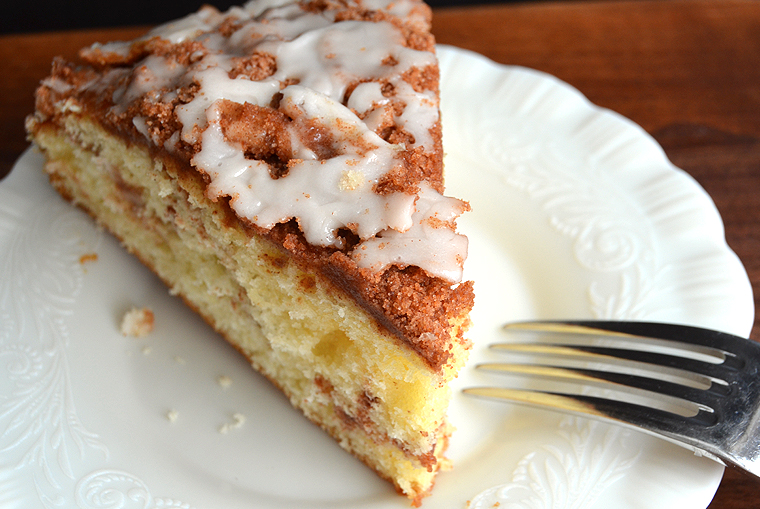
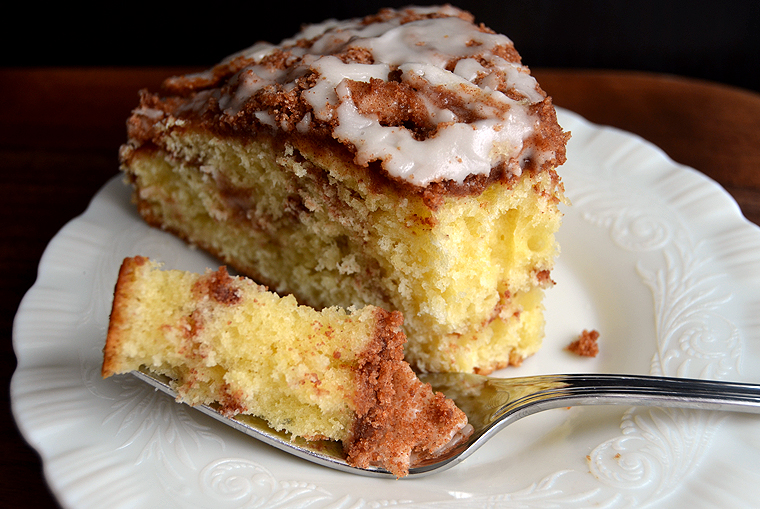
Cinnamon Streusel Coffee Cake with Vanilla Glaze

cinnmoncoffeecake01_copyright2012-2014

cinnmoncoffeecake02_copyright2012-2014

When I woke up this morning the windows were iced over once again, and there is another 3” of fresh snow on top of the dirty gray snow that has been piling up over the last 2 months. I feel like this winter will never end, and as I make a pot of coffee I realize its going to be another depressing day and I’ll need to cheer myself up before heading out into the cold. I think a good old-fashioned cinnamon coffee cake should do the trick!

cinnmoncoffeecake03_copyright2012-2014

cinnmoncoffeecake04_copyright2012-2014

cinnmoncoffeecake05_copyright2012-2014

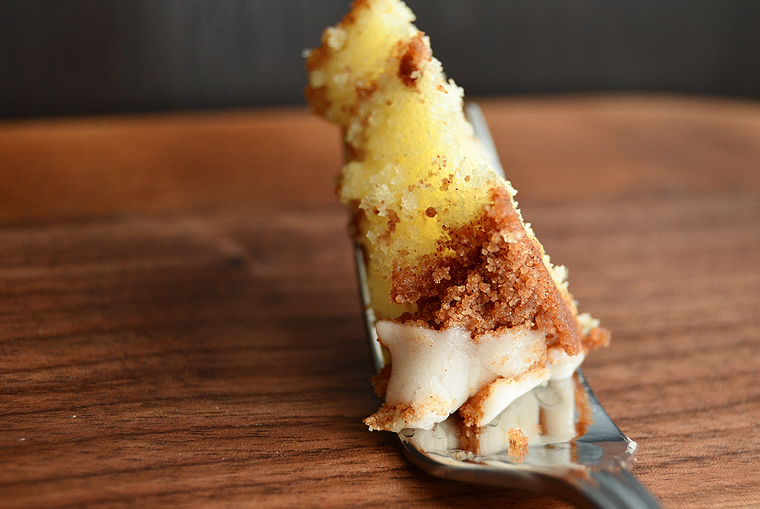
In addition to being quick and easy to make, this recipe will fill your home with the scent of cinnamon and nutmeg, and hot slice topped with a swirl of vanilla glaze is the perfect accompaniment to your morning coffee!

Ingredients:

The cake:

1 stick unsalted butter, at room temperature
1/2 cup white sugar
1/2 cup lightly packed brown sugar
2 eggs
2 teaspoons vanilla bean paste (vanilla extract works too)
2 cups all purpose flour
1 ½ teaspoon baking powder
½ teaspoon baking soda
½ teaspoon sea salt
1 cup Greek yogurt
1 cup powdered sugar
2 tablespoons 1 % milk

Streusel topping:

1 ¾ cup all purpose flour
1 cup lightly packed brown sugar
1 teaspoon cinnamon
1 teaspoon sea salt
1 ½ sticks unsalted butter (butter must be cold)

For the glaze:

1 cup powdered sugar
2 tablespoons cream or milk (I used 1% milk and it still came out right!)
1/2 teaspoon vanilla bean paste (vanilla extract works too)

Instructions

Preheat the over to 350 ºF. Butter a 9-inch cake pan and set aside.

In a large bowl or stand mixer, cream together the butter and sugars. Add the eggs and vanilla paste to the butter mixture and blend until fully incorporated. Add the flour, baking powder, baking soda, and salt and mix until just combined. Add the Greek yogurt and mix until just incorporated, about a minute or so.

In a separate bowl combine the ingredients for the streusel and using a fork or pastry cutter, cut in the cold butter until you have a crumbly mixture. Pour half of the batter into the buttered cake pan and smooth it out to cover the bottom. Sprinkle 1/2 of the streusel mixture on top of the batter and then cover with the remaining batter. Sprinkle the remaining streusel on top of the batter.

Place the cake pan into the oven and bake for 50-60 minutes until a toothpick can be inserted into the center and it comes out clean. Remove from oven and allow the cake to cool completely.

In a small bowl mix together the powdered sugar, milk, and vanilla until smooth, and drizzle over the cooled cake and serve with a glass of cold milk or a cup of hot coffee. Cake will keep in an airtight container at room temperature for up to 5 days.

Interview with Executive Chef Rick Gresh of David Burke’s Primehouse, Chicago

Rick 1

A Cleveland native, Rick Gresh earned his Associate Degree in Culinary Arts at the nationally renowned Culinary Institute of America. While in school he landed an impressive externship at the Waldorf Astoria in New York and after graduation scored a spot on the line at Trio in Evanston. He then moved on to the Celebrity Café at the Hotel Nikko in Chicago before becoming consulting chef de cuisine at Tsunami, a contemporary Japanese restaurant located in Chicago’s Gold Coast neighborhood.

At just 23, Gresh accepted the executive chef position at Chicago’s hip jazz club, Green Dolphin Street. The restaurant thrived under his leadership and won a three-star review from theChicago Tribune. Pat Bruno of the Chicago Sun-Times wrote, “This is serious food.” Gresh’s next move was to The Wyndham Hotel Chicago and the award winning Caliterra Restaurant, where he proved himself once again and was quickly promoted to regional corporate chef. In 2006 Gresh became the executive chef at the prestigious private Saddle & Cycle Club where he oversaw the entire culinary operations.

In 2001 Rick Gresh was invited to host his first dinner at the James Beard House and was named a “Rising Star of American Cuisine”. In 2004 and 2006 he was a USA competition finalist in the world’s premier culinary competition, the Bocuse D’Or.

Over the last two years Rick has earned AOL’s “Best Fine Dining Restaurant in Chicago,”Chicago Reader’s “Best steakhouse,” Chicago Magazine’s “Best Dry Aged Steak” and “Best Bread,” “Top 10 Steakhouses in America” from Gayot. Most recently he has been named one of five “Men to Watch” by Chicago Magazine and Plate Magazine’s “Chef Humanitarian of the Year 2011.”


During my recent visit to Primehouse, I had a chance to interview Chef Gresh about his personal style and cooking philosophy, and about the culinary scene in Chicago; here is what he had to say.

Describe your cooking style in 3 words.
Clean, crisp, and refreshing.

Who are your biggest culinary influences?
Andre Soltner, Sean McClain, & my mom and dad

Is there a particular process you like to follow while creating new recipes?
I like to draw my ideas/plating first using mostly pencil and blue ink. When I look at the drawing it feels like I’m looking at in 3D. I also write down ideas, or if I see something that may be inspiring, that also plays into my process. Then I test with trial and error and play with flavors.

What are the top three dishes at Primehouse that are not to be missed?
Wow. There’s so much good food to try here! I would say the 35 Day Dry Aged Kansas City Strip Steak, Tableside Caesar Salad, Arugula Salad, the Popovers, the asparagus with pickled cranberries, and our new Mac and Cheese with Chorizo, cheddar cheese, jalapeños and crispy tortilla chips.

What are your least and most favorite ingredients to work with?
Most, I would say seafood and vegetables. Least favorite is pig bladder.

What is your favorite grilling trick?
Dry the meat before you grill, brush with herbs and oil.

What are the biggest mistakes most home grillers make?
First, not drying the meat, and then having the grill not hot enough or too hot. Next, not picking the skinniest, wimpiest meat out there. You need a nice, thick cut steak, large enough for 2-3 people to achieve a better char and beautiful browning. Remember that cooking breaks down the meat and fat, and always let your steak rest before slicing it to avoid the juices escaping.

Steaks and beef burgers are pretty common. Are there any foods that are really underrated for grilling?
Cow (skirt, flanks, briskets), veal in the summer on top of a salad, Quail are super easy to grill and cook fast with a crispy skin. I also like to take a pan of chocolate and place it in the grill after I’m done grilling to melt and pick up that “grill flavor”. It’s great for dipping fruit and little cookies/cakes in.

Gas or charcoal?
Charcoal at home!

What is something you personally wish you knew about grilling that you didn’t know when you started cooking?
Temping meat without using thermometers.

Briefly describe a typical day.
Around 7:30 a.m. I lay in bed checking emails from last night. Shortly after I get up and come to work checking in with the sous chefs and line cooks. Next, I go through projects and what-not through the day. I’m typically glued to my phone.

Normally I have 2-6 meetings every day to go over interviews, parties or charity events. I walk around to all restaurants and hotel, Burke’s Bacon Bar, Primehouse, JIMMY and James Hotel (banquets and catering venue upstairs), to make sure all is going well.

Then I sit down and make sure the lists are on point with PR initiatives, events, and travel plans. Between 1-3 p.m. I go through all of our email reports, sales, food costs, labor, etc. At 3 p.m., I meet with the PM sous chefs and go over the night functions. 5 p.m. is pre-shift and we go over that evening’s specials and I fill the crew in on the details. Then we begin dinner service. I’m lucky that every day is different and brings a new challenge.

After a week of working long hours, what do you like to cook at home?
I bake bread every week. My sourdough starter is made from pinot noir grapes. I make a lot of French style baguettes. Also, we are major sports fans in our house, so every Sunday for game day I cook something. Recently, while in Austin, TX, I visited Stubb’s Smokehouse. I spent time talking to them and watching them make their brisket in the smokehouse. I like trying new things, so I experimented at home trying to replicate their brisket recipe.

Besides Primehouse, where do you like to eat in Chicago?
I like to give a restaurant a year after they open before trying it. I find it unfair to judge right off the bat. That is, unless it’s a good friend and they want criticism. I love eating out and trying different things. Recently, I dined at Storefront Company and Azzurra EnoTavola in the same night. Tonight I’m off to Grace, and Embeya is on the list to eat at soon.

What trends do you see emerging in the restaurant industry now?
Meat will be big, most importantly smaller cuts done properly. Middle Eastern and African food will also be a big emerging trend. Also, I think the European Eastern Bloc will also have a new impact on food culture. I think someone will dress it up some, put it in a fun atmosphere and make it more approachable.

Do you have a guilty pleasure you eat when nobody is looking?
Sour patch kids, Zingers (Those are delicious, I love coconut!) and Ben & Jerry’s Americone Dream.

There are many home cooks out there like myself who are not beginners, but nowhere Near professional ability, so I’m wondering what advice you would give us to take our cooking to the next level?
Basics you have to do well. A pan must be hot before searing. Then you can start to experiment with this ingredient vs. that ingredient. Now that’s when the fun happens. Get creative! What’s the worst that can happen? You end up ordering a pizza for the dinner? Not the end of the world. Let go of your fears, make mistakes and make it better! Play with your food; take notes of your success and failures in your recipes. Remember just because you made it doesn’t mean you have to eat it!


Interview with Executive Pastry Chef Jove T. Hubbard of David Burke’s Primehouse, Chicago

Jove 1

After graduating from the American Culinary Federation culinary apprenticeship, Jove Hubbard went on to study baking and pastry arts at The California Culinary Academy in San Francisco. Soon after, he was called to open The Peabody Little Rock Hotel in Little Rock, Arkansas as Executive Pastry Chef.

After four years here, Hubbard relocated to Chicago to study as an intern under Chefs Jacquy Pfeiffer, Sebastien Canonne, and John Kraus at The French Pastry School. Following his continued culinary education with these renowned chefs, Hubbard held the role of executive pastry chef at The Windsor Court Hotel in New Orleans before his current position as executive pastry chef at The James Chicago hotel.

At The James, Hubbard oversees the dessert program at David Burke’s Primehouse, where he masterminds whimsical and creative desserts signature to the David Burke brand. At the hotel, he oversees all aspects of pastry production, including in-room dining, banquets and special events, custom wedding cakes, and all other luxury hotel amenities.

Recently I had the pleasure of sitting down with Chef Jove T. Hubbard, the Executive Pastry Chef of David Burke’s Primehouse in Chicago, to ask him a few questions tailored  to take a peek at the personality behind his impressive bio.

Describe your pastry style in 3 words.
Clean, classic, and thoughtful

Who are your top culinary influences?
Jacqui Pfeffer, Sebastien Canonne, and John Klaus. They really brought a whole new level of pastry to the US. It’s the way they work (French cuisine).

Is there a process you go through to create a new dessert?
Typically I start working on them a couple of months in advance. I generally know how it’s going to taste before I make it.

What are some of the new desserts you’ve been working on?
I’m putting the finishing touches on a new chocolate tart, pairing Cacao Barry chocolate with coffee ice cream, and whiskey caramel pecans. A new pear tarte tatin with sassafras ice cream and bergamot puree with earl grey tea and crystalized ginger.

What is your favorite dessert at David Burke’s Primehouse?
Madirofolo chocolate tart with chocolate financier, coffee ice cream and whiskey caramel pecans.

Name three of dishes a first time diner at Primehouse should try?
Popovers! Duck egg crème brûlée and the cheese course.

Who are some of your mentors? What have you learned from them?
Chef Rick Gresh. He has taught me about cheeses, I always ask for his input and he comes back with a twist I didn’t think of. He has also taught me how to work with more savory flavors.

What advice would you offer young pastry chefs just starting out?
Try to work in as many kitchens as you can, spending 1 year in each kitchen. Work with different chefs and experience different perspectives. If you don’t, you won’t get the real world feel. Working in a restaurant is not so much a novelty but a whole different experience and skill set compared to working in a hotel. I worked in a hotel restaurant and it’s a production. You need both experiences.

What trends do you see emerging in the restaurant industry now?
I see molecular gastronomy techniques really maturing and the return of classic pastry. Good viable techniques are still around.

What is your favorite off the beaten path restaurant in Chicago?
Ruxbin.

What are a few of your favorite flavor combinations?
Blood orange with coconut, Pecans/chocolate/coffee/whiskey, Strawberry with yogurt or fresh cheeses.

Is there a particular chocolate company you like to work with?
Cacao Barry for sure!

What are your top three tips for pastry success?
1. Don’t ever let anyone tell you one method is the best because that’s not always the case and is a common mistake. 2. You should always keep something in your back pocket. Chefs may want a new menu to come out, they will have theirs prepared and you should always carry a spontaneous new menu with you. 3. Don’t be afraid to do something that’s already been done. There are so many great recipes that have been handed down. There is no need to over complicate, make something classic and learn to do it very well.

It seems like chefs often open their own restaurants but pastry chefs seldom do. Would you ever open your own place?
Definitely! It’s hard for pastry chefs to whittle down what they want to do. Pastry is a big field with many areas of specialty. You can’t do all of it. And there is a savory side as well.

Where would one find you on your day off?
Watching sports, cycling, hanging out with friends and barbecuing in the summertime.

Do you have a guilty pleasure? Something you eat when nobody is looking?
Pizza! My favorite topping is mushroom.

After a week of working long hours, what do you like to cook at home?
Soups! Chicken, black-eyed peas, red beans and rice and in the summer I barbecue a lot.

There are many home cooks out there like myself who are not beginners but nowhere near professional ability, so I’m wondering what advice you would give us to take our baking to the next level?
Take a class! I highly recommend the French Pastry School or the Chocolate academy (even though it is more specific). Learn the techniques and practice the recipes over and over again until you perfect it.

David Burke’s Primehouse, Chicago

davidburke_primehouse_1_copyright2014

The moment I entered Primehouse I was greeted by a wall of aromas, the most dominant of which was the rich, meaty, charred scent of perfectly grilled steak. My stomach immediately spoke up to remind me that I love steak, especially at a really good steakhouse. As the name implies, Primehouse is just such a place, and what Chefs Rick Gresh and Jove Hubbard had in store for me did not disappoint. It comes as no surprise that Chicago Magazine voted Primehouse the #1 steakhouse in Chicago in November, 2013.
davidburke_primehouse_2_copyright2014

davidburke_primehouse_3_copyright2014

davidburke_primehouse_9_copyright2014

David Burke’s Primehouse opened its doors in 2006, and is located in the chic James Hotel in Chicago’s legendary Magnificent Mile neighborhood. What it presents is modern American steakhouse cuisine, imaginatively interpreted with imagination and playfulness. When it comes to prime cuts of meat, James Beard award-winning chef David Burke believes in serving only the best. In fact, he owns his own 2,500-pound Black Angus Bull, whose name is Prime. Prime roams the rolling green pastures of Creekstone Farms in Kentucky and is the exclusive source of all of the high-grade meats served in all of Chef Burke’s establishments. Executive Chef Rick Gresh heads the kitchen in Chicago, and has created a menu featuring five grades of dry-aged steak.  The meat lingers in a custom-built ageing room on premises, its walls lined with slabs of Himalayan salt.  The five depths of intensity are accomplished by ageing the beef for 28, 35, 40, 55, or 75 days, far beneath the dining room floor. For especially demanding diners, rumors exist of off-menu steaks which have been carefully aged for 130 days, which are of extremely uncommon availability. In addition to the steaks, the menu also features locally-sourced and seasonally inspired dishes and a phenomenal table-side-prepared Caesar salad.
davidburke_primehouse_4_copyright2014

davidburke_primehouse_8_copyright2014

davidburke_primehouse_5_copyright2014

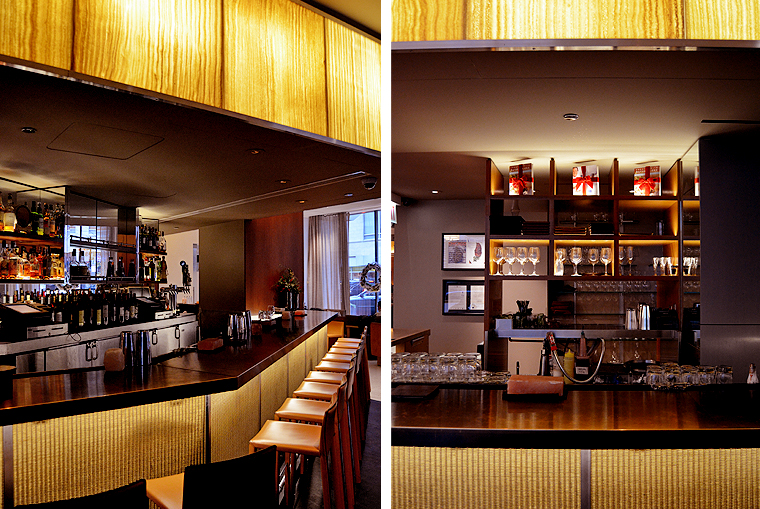
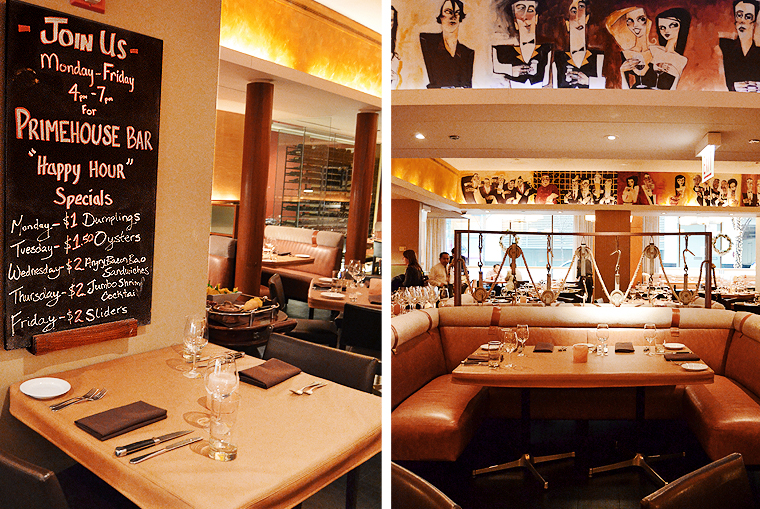
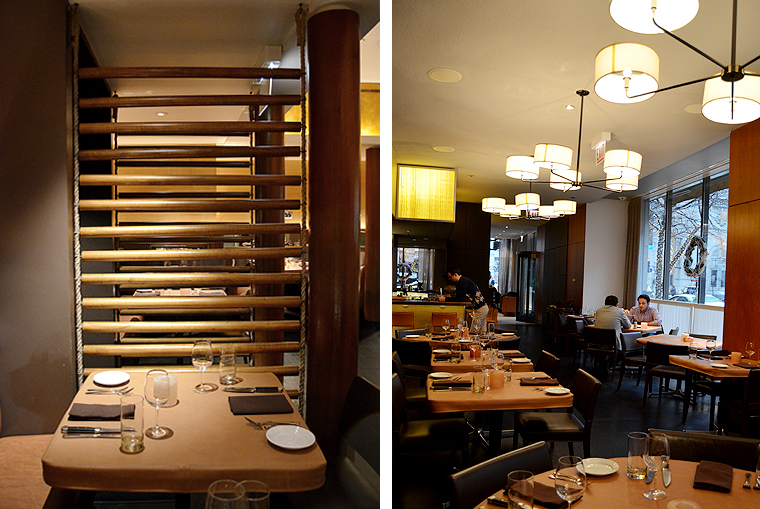
Primehouse is the perfect place to celebrate a romantic evening or to conduct an afternoon business meeting.  It is posh and elegant, with an inviting atmosphere. When I arrived mid-day, there was lounge music in the background, and the mood was perfect for business. Even early in the day the scent of steak filled the air, and the tables are topped with stitched leather echo the attention to detail of the entire dining experience. The bartender is attentive and courteous, if you’re not sure what to order, tell him what you like and he will recommend something you will certainly enjoy. Overall, the service was impeccable. The waitstaff are professional, attentive, and informed no matter what question you throw their way.

davidburke_primehouse_6_copyright2014

davidburke_primehouse_7_copyright2014

Food
In order of arrival;

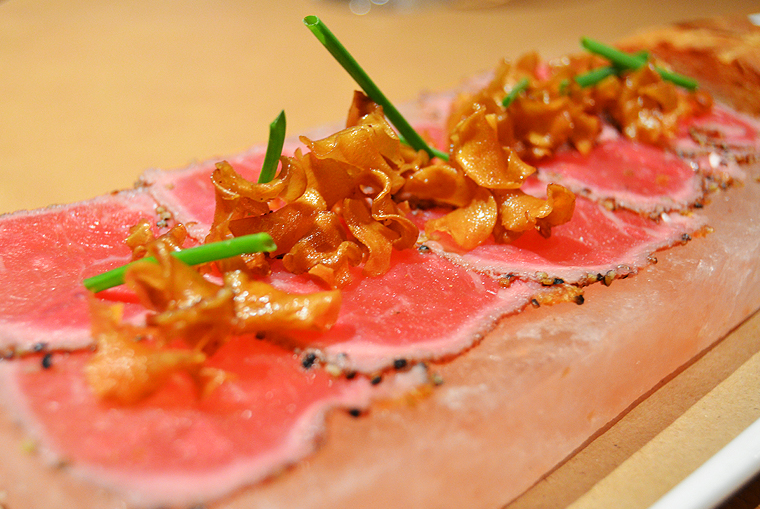
Wagyu Beef Sashimi served on a slab of Himalayan salt with Mushroom Chips, Truffle Aioli and Croutes.

The freshly sliced Wagyu sashimi was fresh, light, and tender. The freshly ground pepper coating adds a lot of dimension without overwhelming the delicate flavor of the beef. In fact, the combination of raw beef and freshly ground black pepper reveals an herbal quality of the pepper that isn’t apparent in cooked dishes. It is accompanied by truffle aioli and slices of crisply toasted baguette. The flavors were spectacularly clear, and the earthiness of the truffle aioli didn’t compete with the clean taste of the raw beef. But what I liked most about this dish is that it is served on a beautiful slab of pink Himalayan salt, so as you eat the sashimi the level of saltiness increases; I was intentionally taking my time so that the last two or three slices had developed an intensity approaching that of caviar. Exquisite. I’ll be back if only to enjoy this one dish.

davidburke_primehouse_10_copyright2014


Pan-seared Scallops with Roasted Red Pepper, Blood Orange and Red Chili with Shaved Scallions

These perfectly seared succulent scallops were among the largest I’ve ever eaten. The richness of the scallop was sharply punctuated by the sweet tang of the blood orange; the spicy chili and roast red pepper erase any hint of marmelade flavor. I’m a big fan of scallops, and these were perfection. I rarely finish everything on my plate no matter if I’m eating out or at home. With this dish, I had a clean plate just a few moments.
davidburke_primehouse_11_copyright2014

35 day dry-aged Kansas City Sirloin Steak

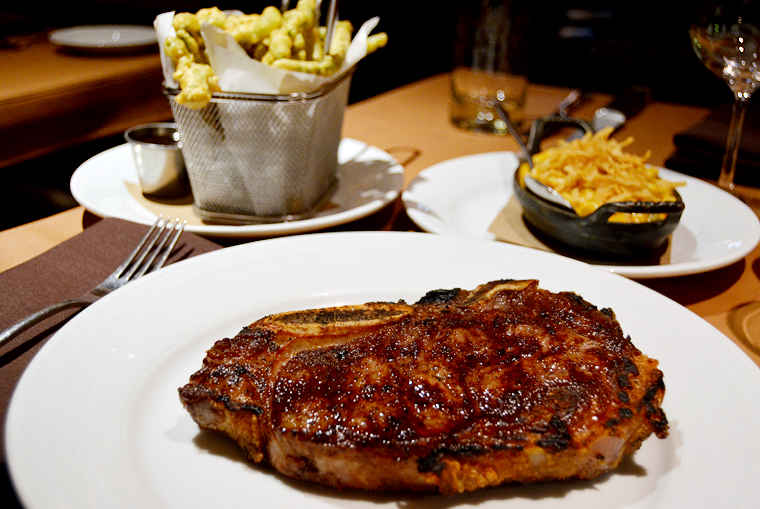
Let’s get down to business. This is, after all, a steak house. Chef Gresh had selected a 35 day dry-aged Kansas City sirloin bone-in steak, which was beautiful. Over 2.5 inches thick, and spanning my plate from rim to rim; though the outside was thoroughly charred, the interior was medium rare as recommended, and was cooked to perfection. This steak melted in my mouth with a depth of beef flavor surpassing anything I have ever tasted. The fat was crisp at the edges, then tender, buttery and delicious. I almost always trim the fat from my steak, but not this time, honestly I can’t see how a steak could taste any finer than this one. Beyond the flavor of a great cut of beef, you can taste the skill and experience of everyone involved in crafting and ageing the finished product. Of special note are the bites of steak next to the bone; these are the most tender and flavorful so take the time to savor them.

davidburke_primehouse_12_copyright2014

davidburke_primehouse_13_copyright2014

Tempura Green Beans

The tempura fried green beans are a great alternative to french fries, and if not healthier, they certainly are more flavorful. They were crisp, not a bit greasy, and came served in a deep fryer basket lined with parchment. The lightly breaded, crisp beans paired perfectly with the teriyaki sauce.

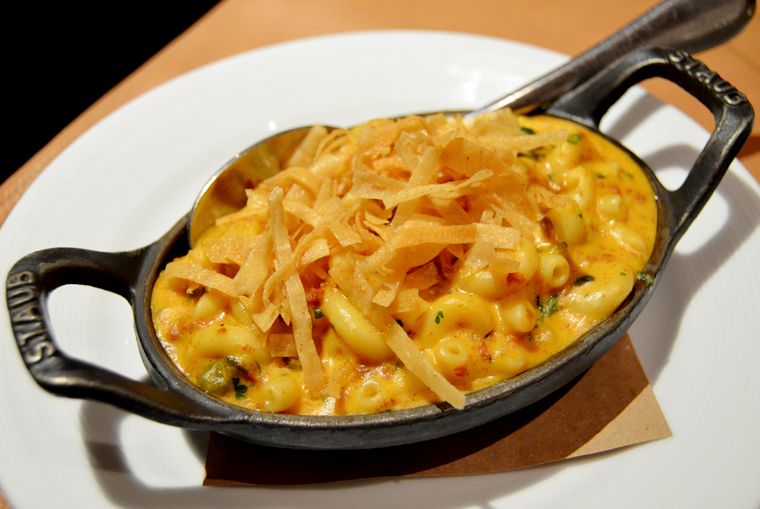
Mac N’ Cheese with Mexican chorizo, Charred Jalapenos, Aged Cheddar Cheese, Cilantro, and Corn Tortilla Strips.

It’s hard to think of many dishes as familiar as macaroni and cheese. When it comes to comfort foods, Mac N’ Cheese is the gold standard but when you add the spicy Mexican flavors, it suddenly becomes exotic. The creamy combination of aged cheddar, savory chorizo, and spicy charred jalapenos will get your attention, and result in a creamy kick that melts in your mouth. Golden baked and topped with tortilla strips to add crunch, macaroni has never had it so good. Great choice as a side for a great steak.

davidburke_primehouse_14_copyright2014

Dessert

The work that Pastry Chef Jove Hubbard produces at Primehouse are surprisingly sophisticated for a steakhouse, but then again, this isn’t just any steakhouse, this is Primehouse. Rivaling the finest France has to offer, his beignets, financiers, and Tarte tatin are spectacular. His desserts feature flavor combinations that are complex but extremely well thought out. As each arrived at my table, I felt a wave of regret for ruining his exquisitely composed plates with a dull spoon, but as each featured delicately flavored ice creams there was no time to waste and so I had to dig in!

First Dessert

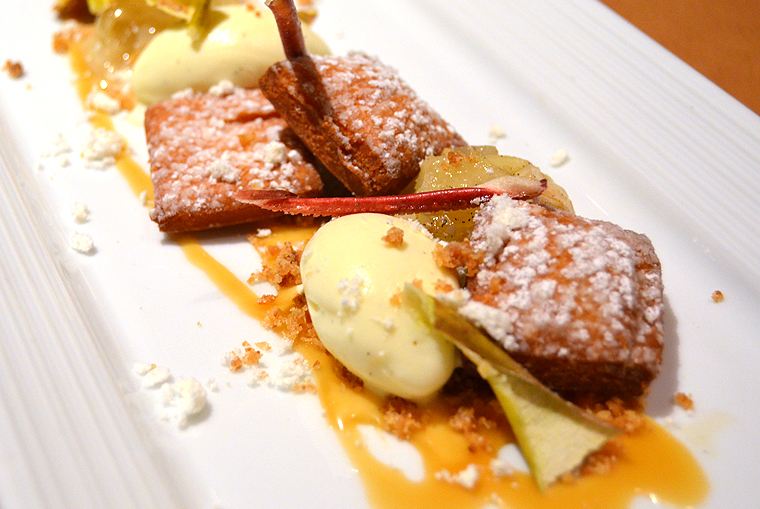
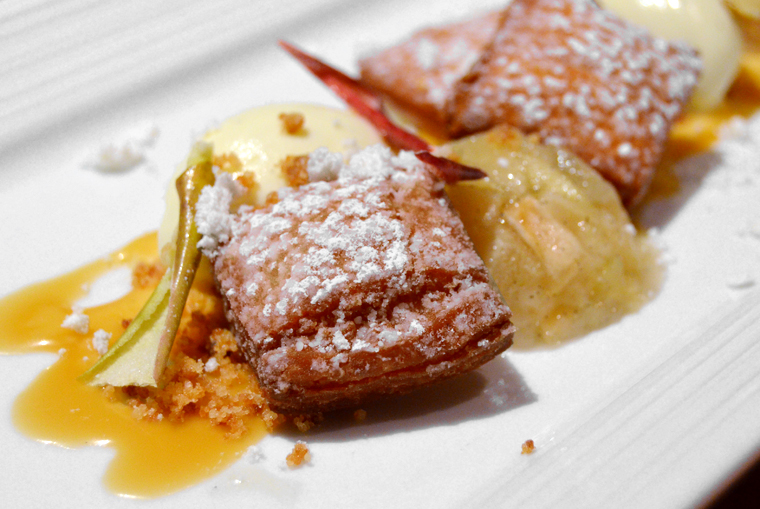
Apple Cider Beignets with Apple Confit, Smoked Vanilla Ice Cream and Dehydrated Apple Cider

I haven’t had beignets like this since I was in France. Beignet is the French word for bump, which are made of choux pastry dough. The decadent deep-fried cream puff was golden, light, buttery, and crisp. A light dusting of powdered sugar added just the right amount of sweetness, and was balanced by the tart apple confit. The ice cream was flavored with smoked vanilla, which was a surprising addition, melting on the tongue, revealing smoke, leather, and cream. Vanilla as a flavor usually takes a back seat to other flavors, but this full-bodied, well executed example shows off what vanilla can be when it grows up. The rich vanilla flavor adds a creaminess to the beignet and smooths out the tart apple flavors; a sweet finishing touch of dehydrated cider was a whimsical addition, and brings the apple to the front of the palate.
davidburke_primehouse_15_copyright2014
davidburke_primehouse_16_copyright2014

Second Dessert

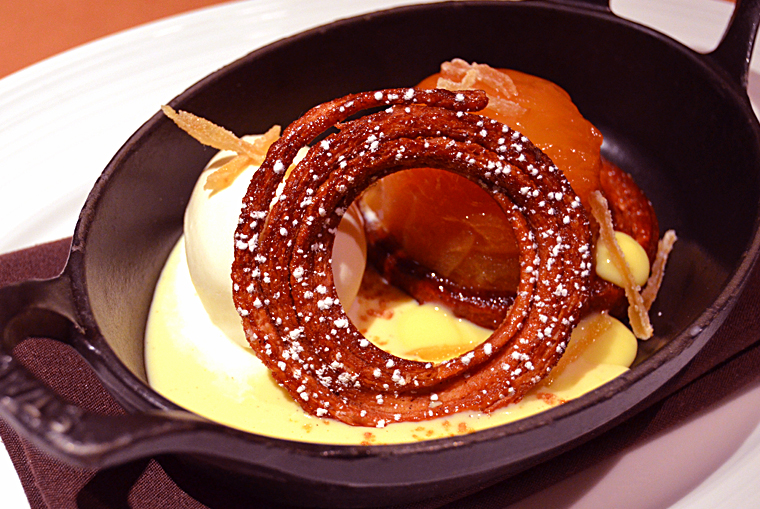
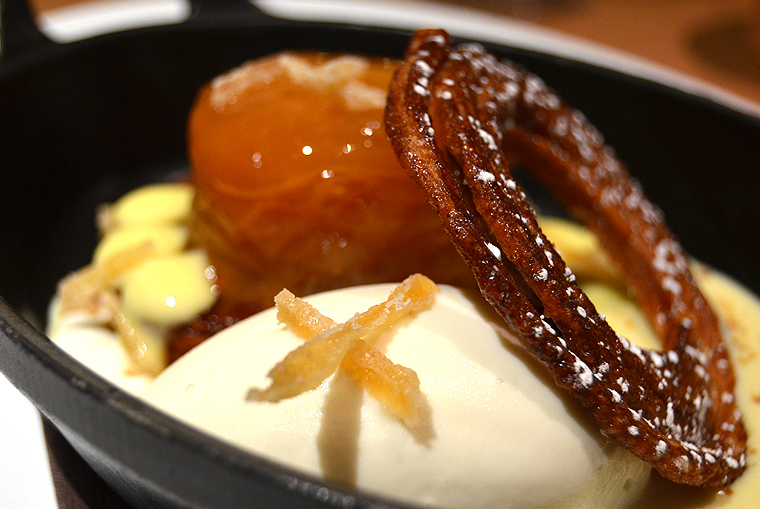
Bosc Pear Tarte Tatin with Sassafras Ice Cream, Lemon Cream, Puff Pastry with Crystalized Ginger

I anxiously awaited this dessert. In our interview Chef Hubbard mentioned that he was developing a pear tarte tatin, I was excited as I have studied these in my French cookbooks, and tarte tatin is one of my favorite French desserts. Chef Hubbard nailed it, renewing my devotion to this particular dessert. The distinctive spiced flavor of Bosc pears, with sassafras ice cream and crystallized ginger flowed together beautifully, and the first bite reveals his true intention, to evoke the flavors of gingerbread on the tongue. A hint of lemon cream cuts the sweetness without being tart, and a hint of speculoos flavor lingers on the finish. What a complex dish, and a great variation on a French classic!
davidburke_primehouse_17_copyright2014
davidburke_primehouse_18_copyright2014

Third Dessert

Chocolate Pecan Financier with Madirofolo Chocolate, Coffee Ice Cream, with Whiskey Caramel and Whiskey Pecans

The description sounds overly rich but thankfully, it has the perfect balance of rich chocolate and doesn’t make you reach for a glass of milk. This is the kind of chocolate decadence I love, one that doesn’t make me reach for a glass of milk. The financier is traditionally cooked in a madeleine bakeform, but Chef Hubbard wisely chose to make them on a waffle iron, which adds a delicate crispness that the traditional sort lack. It was rich and buttery, with grape-sized, whiskey-laced caramel eggs that melt in your mouth. The sweet chocolate and caramel flavors are balanced by a jolt of coffee ice cream. The addition of salted, candied whiskey pecans add crunch and a nice counter to the espresso flavors of the ice cream, and I could honestly eat this dessert for breakfast. Every day.

davidburke_primehouse_19_copyright2014
So which is the best steakhouse in Chicago? You could debate this for hours, but I agree with Chicago Magazine. For an elegant meal, an incomparable steak and sophisticated desserts I’ll book my table at David Burke’s Primehouse. Stay tuned when ACooksCanvas visits Burke’s Bacon Bar and Jimmy, for a martini-fueled evening of fun!

Homemade Cranberry Sauce

cranberry sauce

In my family, we always had cranberry sauce on the table as part of every holiday dinner, including Thanksgiving, Christmas and even Easter. There is something fun about opening the can and watching the molded shape as it slowly slides out onto the plate.  While living abroad I was disappointed that canned cranberry sauce was nowhere to be found in Germany, and to enjoy the taste I would have to learn to make it myself.
cranberry sauce

cranberry sauce_7

Last December was the first time I made my own cranberry sauce; we had invited some close friends over for a Christmas dinner, some of them European but a few Americans would be there too, so I knew I had to serve cranberry sauce. My first recipe consisted of fresh cranberries, sugar, orange juice, and lemon zest. This year, I experimented a little. What could I add to this recipe to give it a little something more? The answer turned out to be red wine. But then isn’t wine always the answer?
cranberry sauce

cranberry sauce_6

cranberry sauce_2

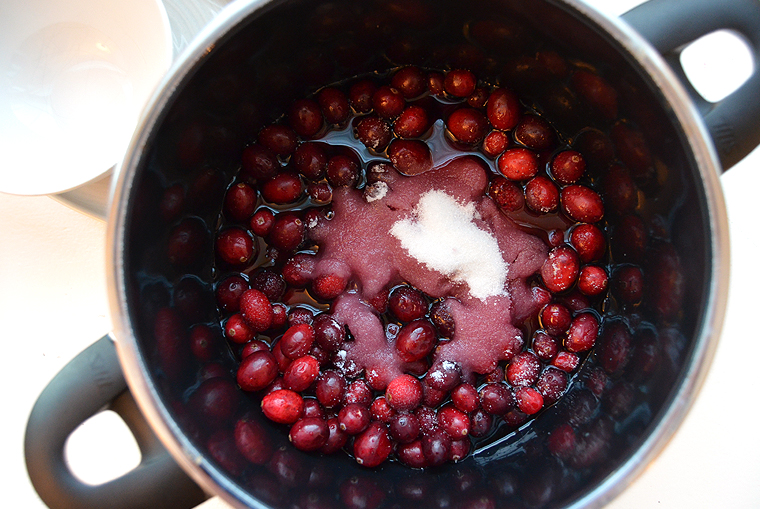
A splash of good wine adds depth and flavor to any dish. This cranberry sauce has a bright, tangy, sweet flavor, and provides a nice contrast to rich holiday foods. This recipe is not only simple (only four ingredients) but it takes only about 20 minutes to make. Another plus is that you can prepare it up to 5 days in advance. Its beautiful color, and delicious flavor will surely be a hit on your holiday table.
cranberry sauce_4

cranberry sauce_3

cranberry sauce_1

cranberry sauce_10

Ingredients
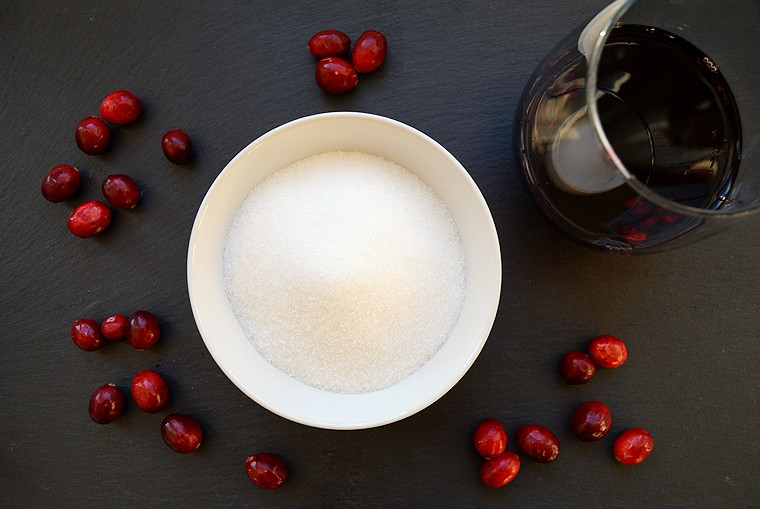
12 ounces fresh or frozen whole cranberries (about 2 1/2 cups)
1 cup white sugar
1 cup dry red wine (I used cabernet sauvignon)
a small pinch or two of lemon or orange zest

Instructions
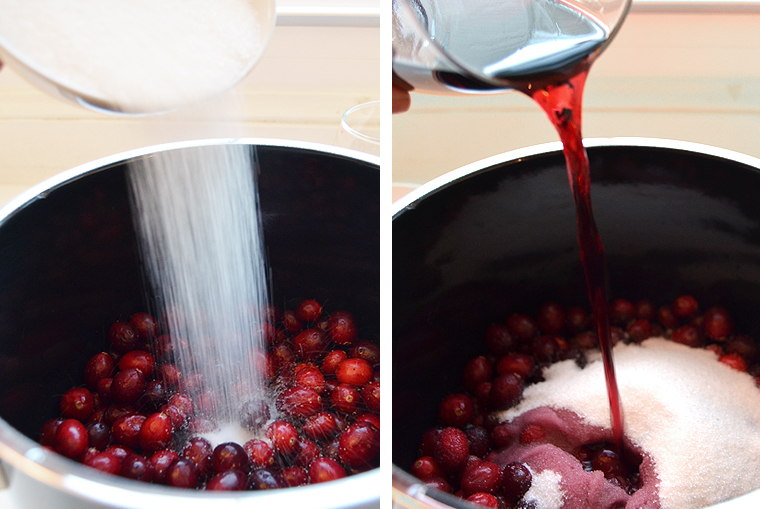
Over medium high heat in saucepan combine cranberries, wine, and sugar. Place lid on the sauce pan and bring to a steady boil. If the mixture is splattering, your heat is too high. After 10 minutes reduce heat and simmer, stirring often until the cranberries have burst and released their juices. The mixture will foam as it simmers. Add a pinch of lemon or orange zest, stir and let cool. Note, the mixture will thicken as it cools.

First Glimpse Inside Eataly Chicago

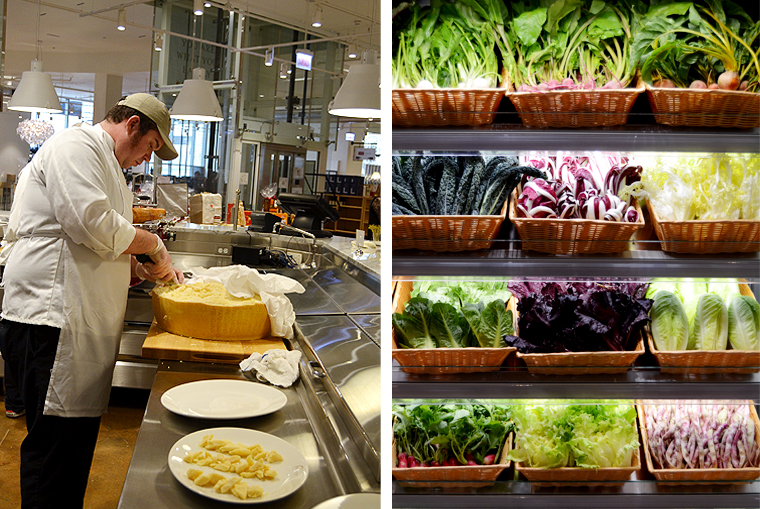
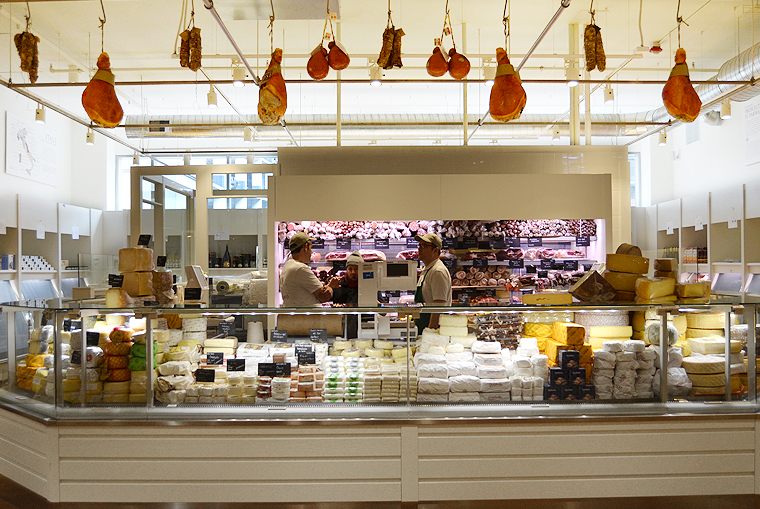
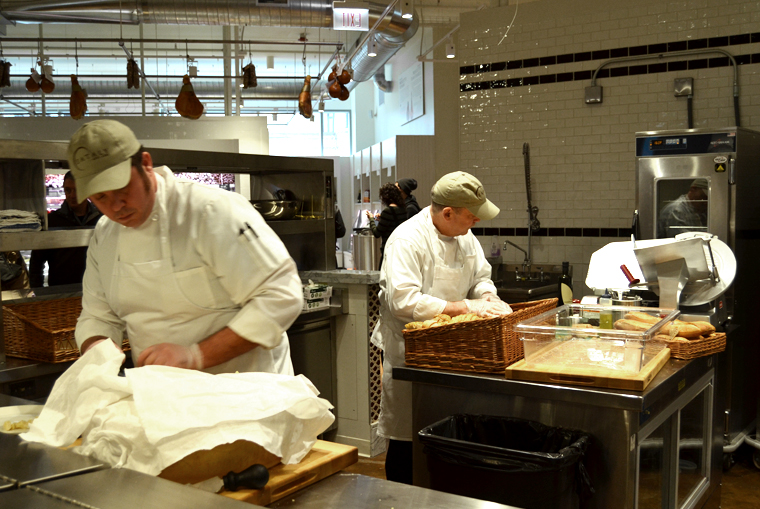
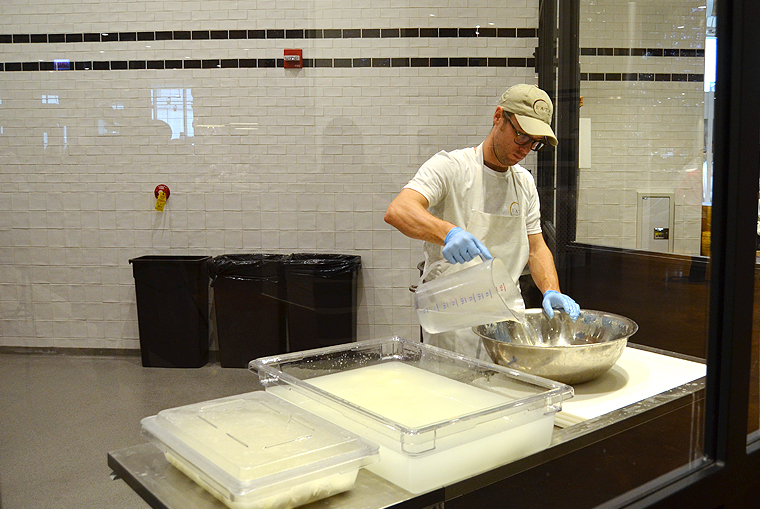
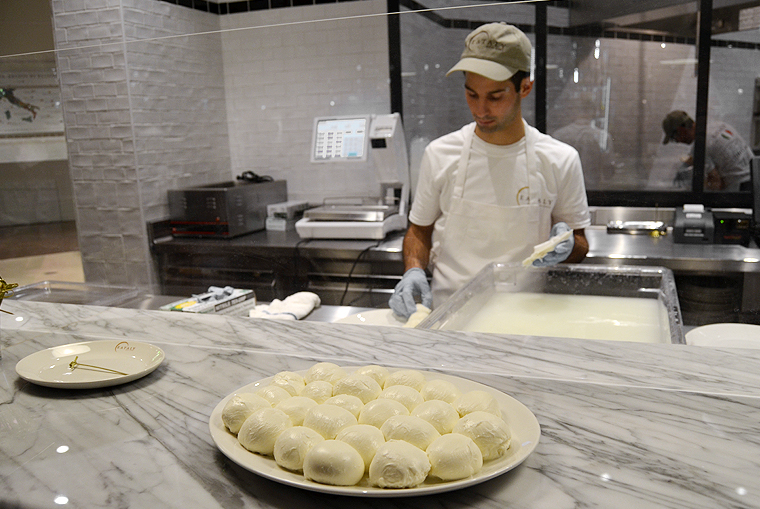
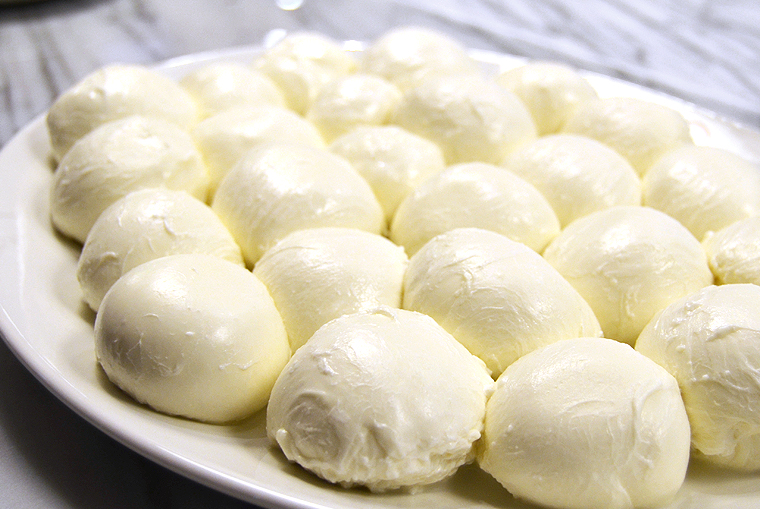
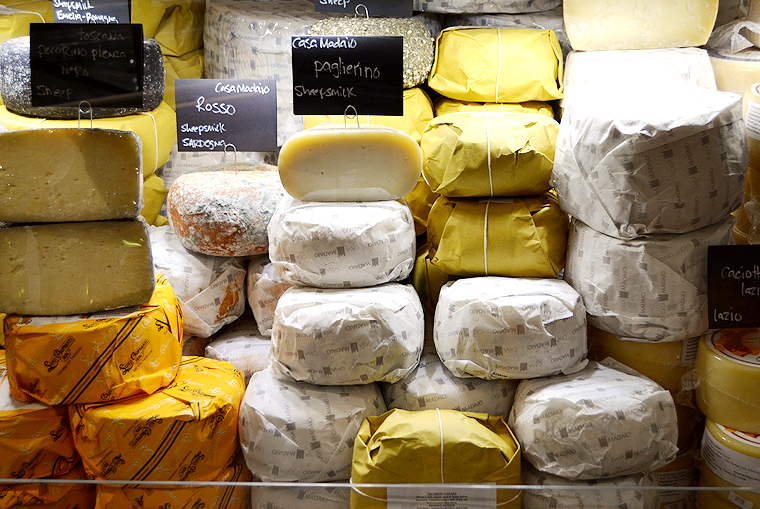
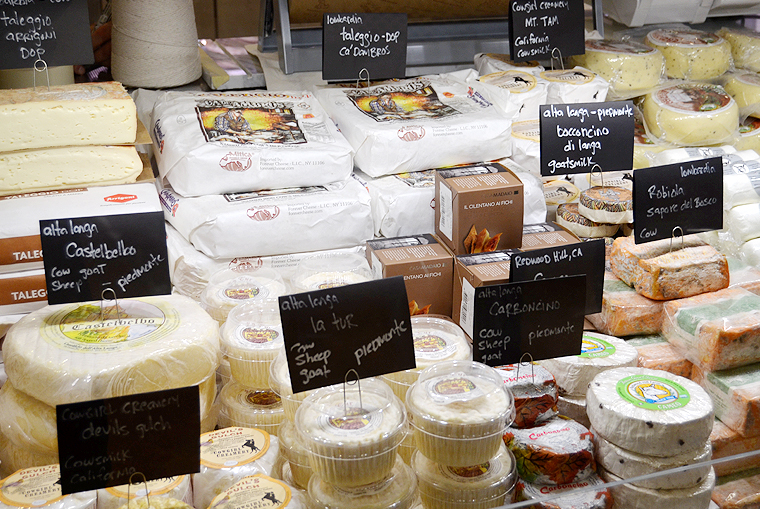
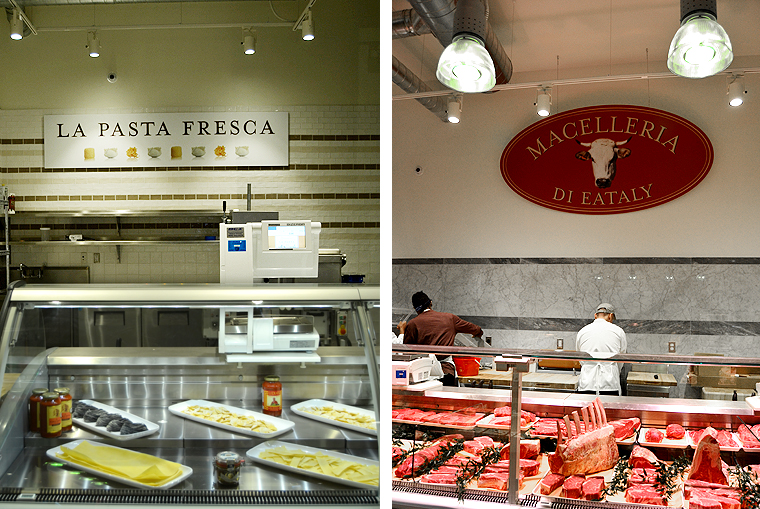
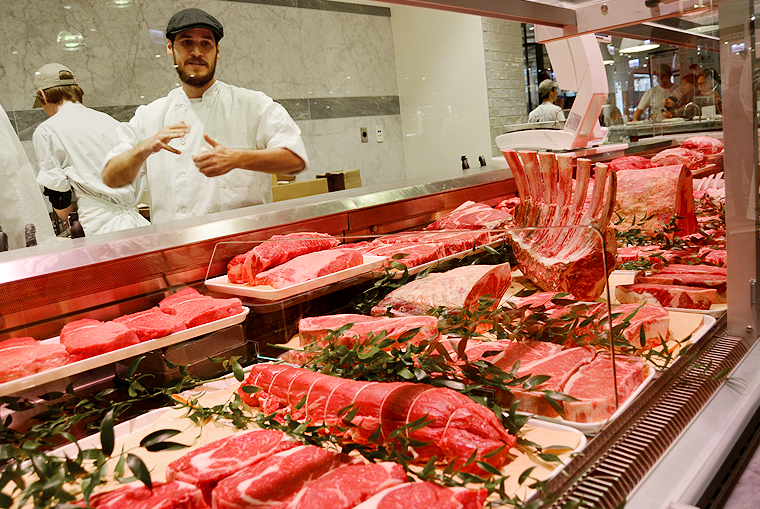
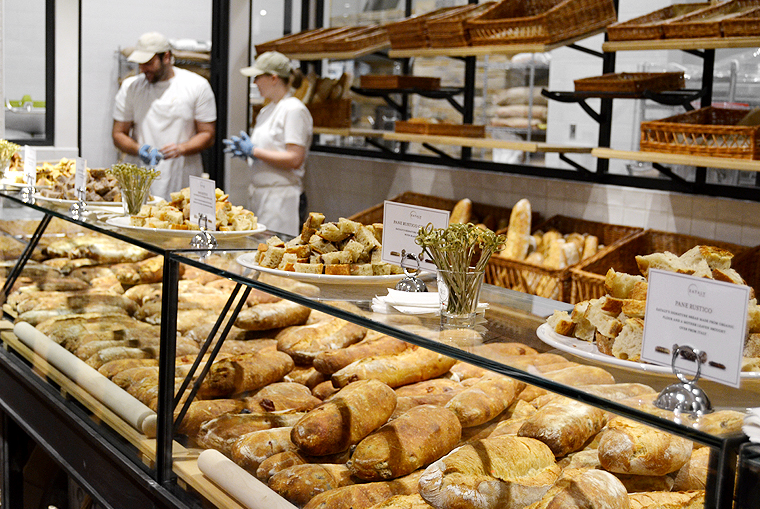
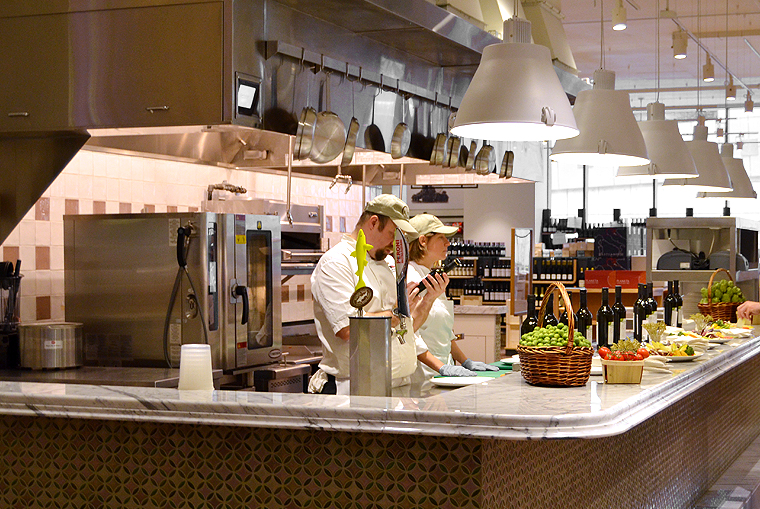
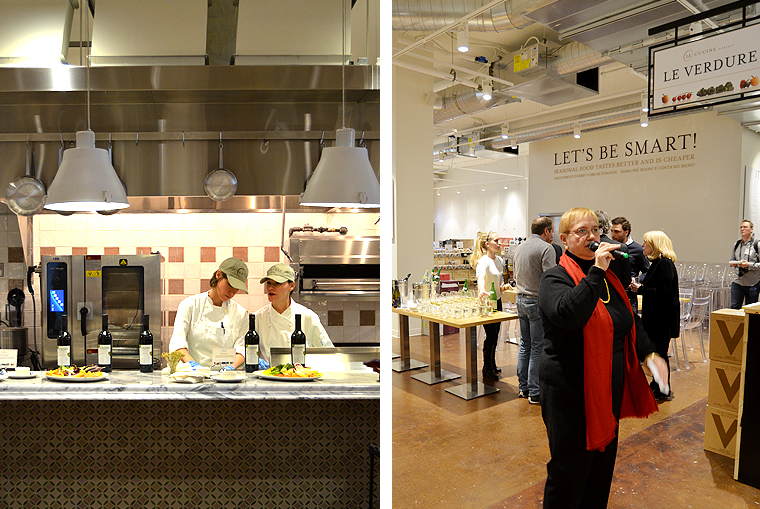
eataly_36In just five days, the new, massive Italian food market Eataly opens, transporting shoppers on an authentic Italian shopping experience unparalleled in the Midwest. Located at 43 E. Ohio Avenue, and boasting 63,000 square feet, will offer imported and artisanally produced local food products, presented in an authentic European-style market featuring a highly trained staff specializing in their craft; you can meet the bakers who produce the rustic, authentic loaves stacked neatly in rows; the butchers proudly display their meats and sausages; and the cheese specialists are happy to discuss their hand-made mozzarella and imported Italian cheeses while the knowledgeable Sommelieri are eager to recommend the perfect wine to pull it all together.

eataly_45

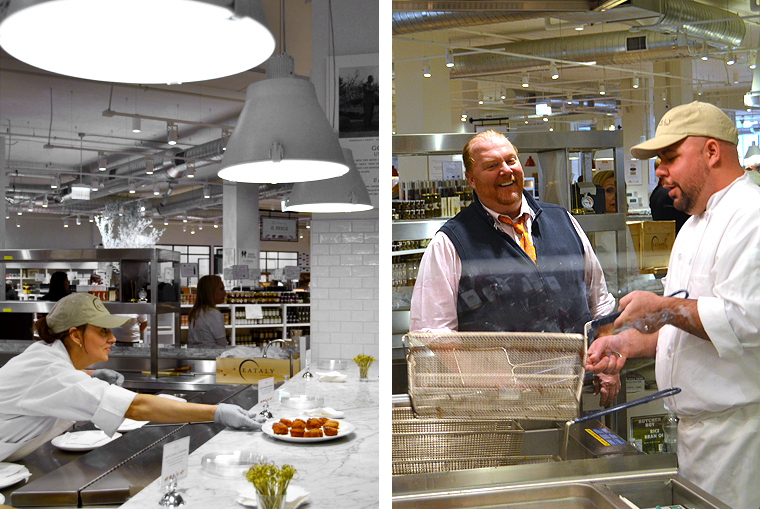
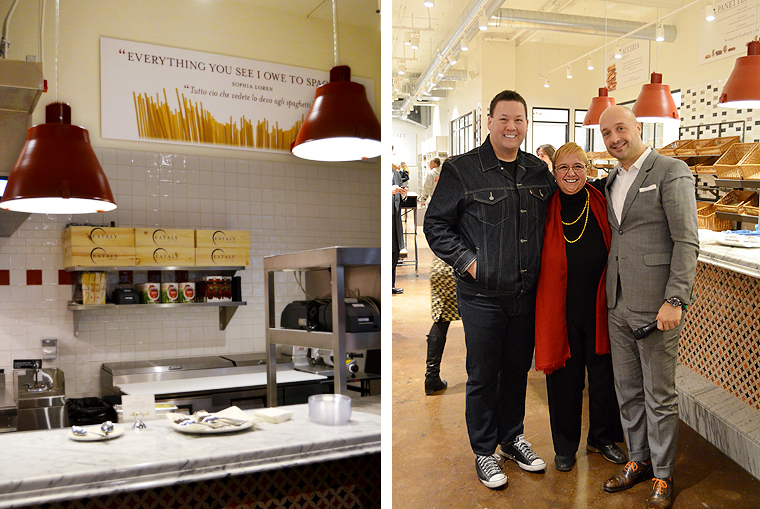
Together with partners Joe Bastianich and Lidia Matticchio Bastianich; Mario Batali has created something special for Chicagoans. Having lived in Europe for a few years, I can attest to the authenticity of this style of shopping; in the cities and small villages across central Europe, this is the way most people buy their food. You get to know your grocer; and they get to know you.  What you like, what you don’t, and when to alert you to newly arrived specialties that are not to be missed. The Eataly experience is modeled on this concept, and in fact is based on the legendary open-air market Campo de Fiori in central Rome. With eleven locations across Italy, four in Japan, and one in New York City, Eataly celebrates its newest location in downtown Chicago.
eataly_27


eataly_48

eataly_46
eataly_18

eataly_25

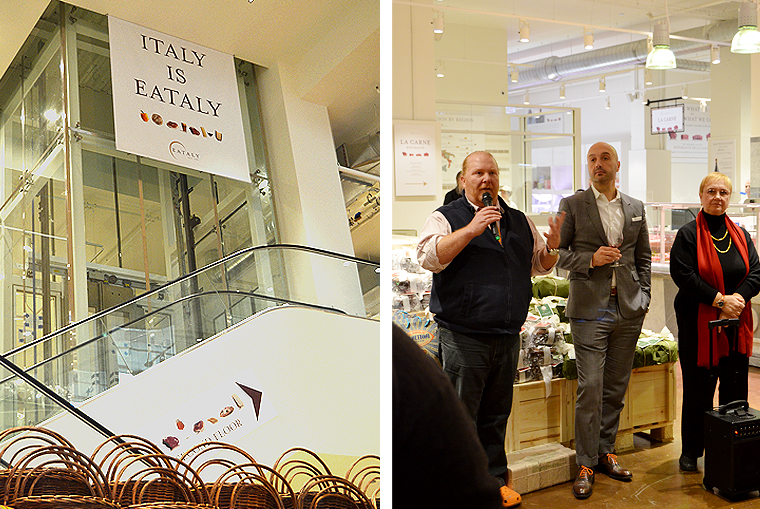
I recently attended the press preview of Eataly Chicago, and I was thoroughly impressed with the variety of products and the attention to detail. As Chef Mario Batali explains, the Chicago location is dedicated to Ernest Hemingway, an Oak Park native, who spent a considerable time in Veneto, Italy. While living there from 1918-1954, Hemingway developed a great love of Italian wine and cuisine, and Eataly commemorates his life in Italy with photos of the author displayed prominently throughout the second floor. Chef Batali hopes to inspire a similar love of Italian food among Chicagoans by offering authentic Italian ingredients in an authentic market setting. “We cook what we sell, and we sell what we cook; and when you taste something here, we want you to know, that you can make it yourself at home” says Chef Batali. “Our customers love that at the end of the day, when they walk out of Eataly, they haven’t spend more than they would have at their normal grocery store.”

eataly_13

eataly_16
eataly_15

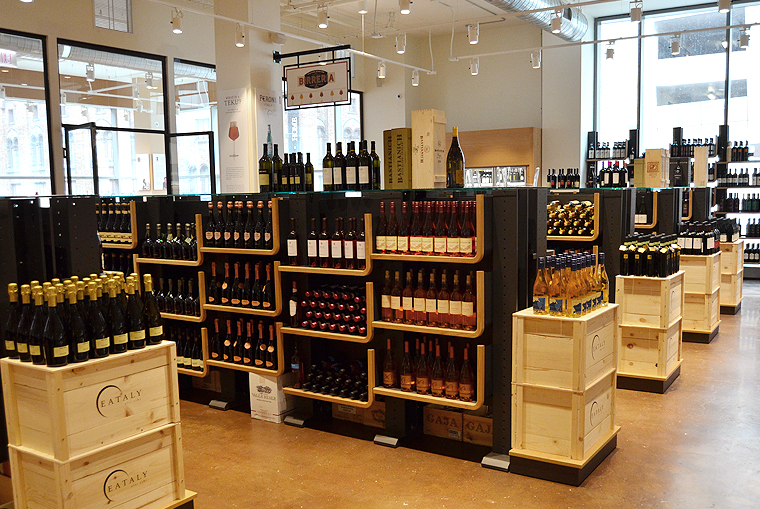
Compared to the New York location; Eataly Chicago is larger, offers more restaurants, and sells wine throughout the market, whereas in Eataly New York, the wine area is separate from the main shopping areas, according to New York state law.

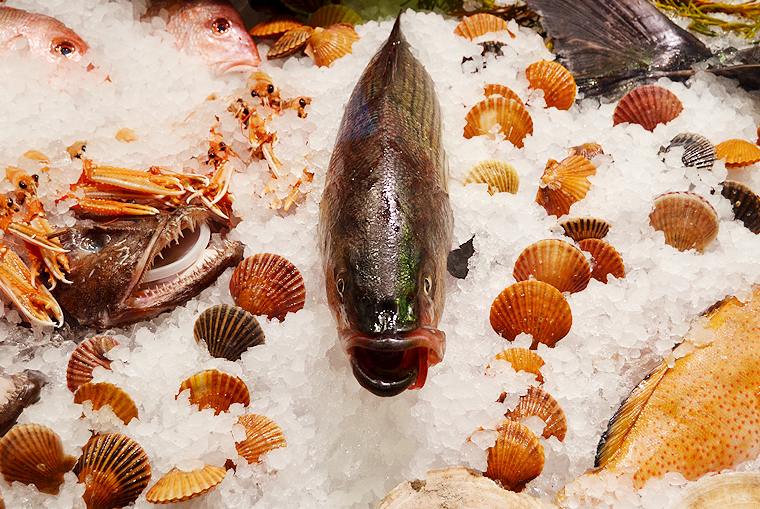
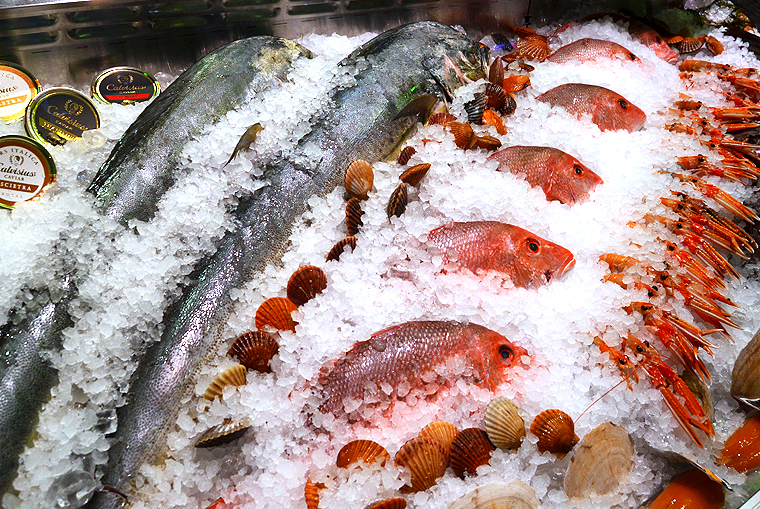
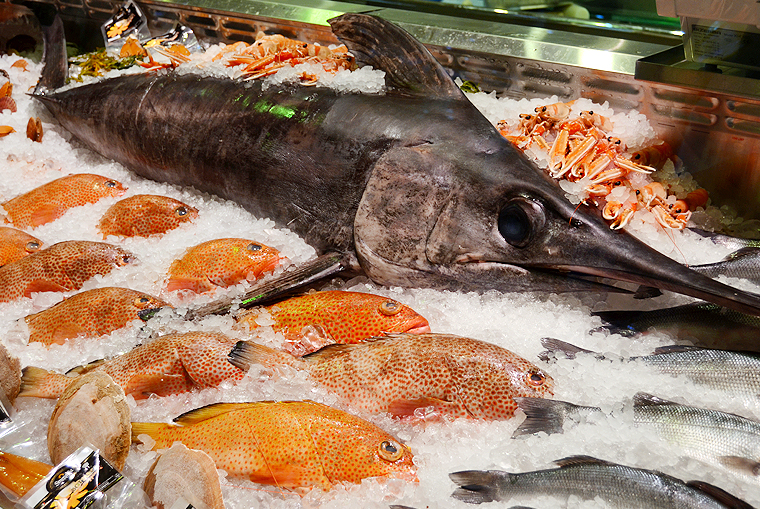
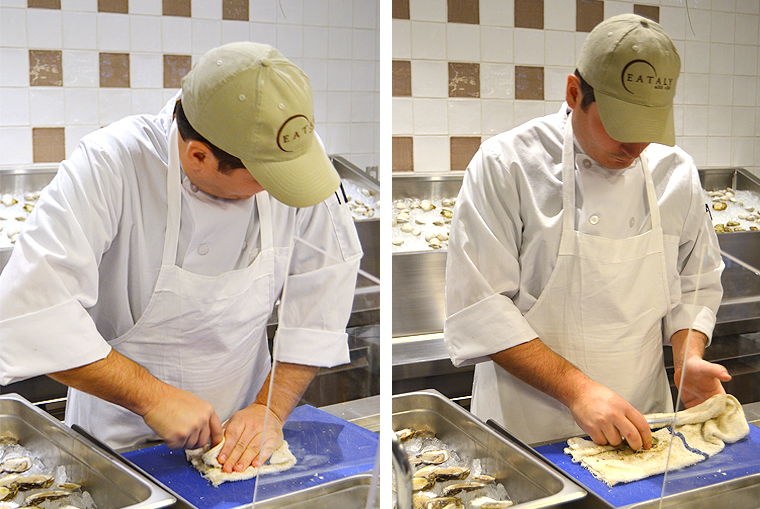
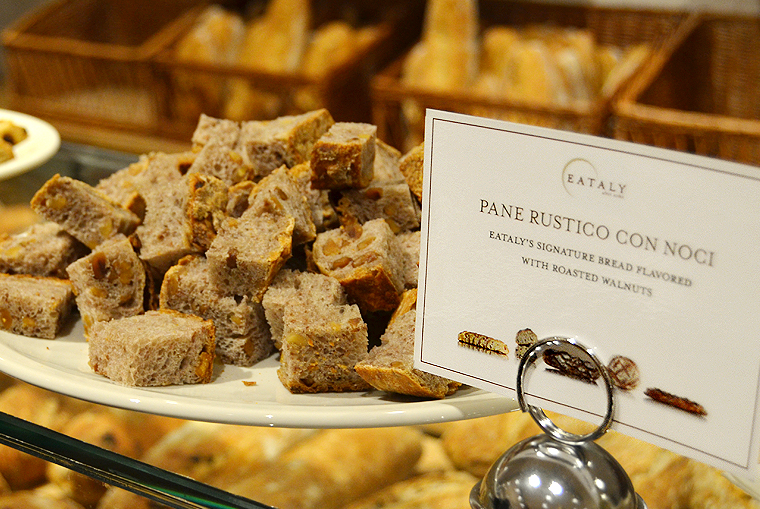
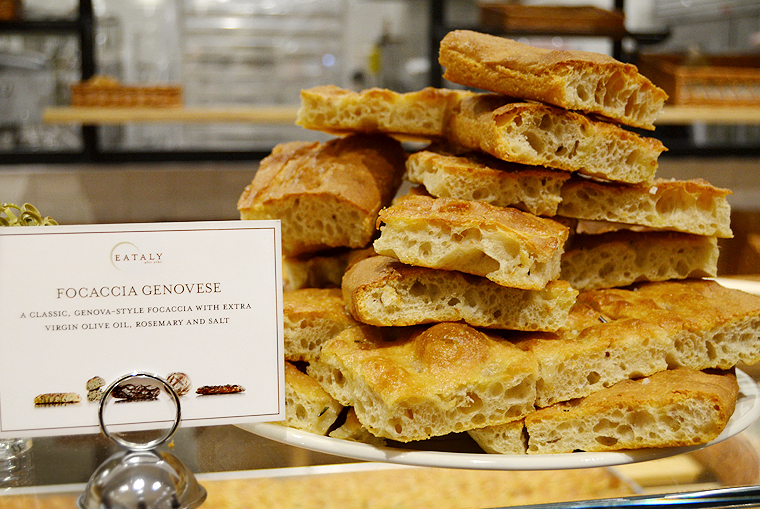
At Eataly Chicago, you will find 21 counters offering cured and fresh meats, fresh seafood, cheese, bakery, and pastry. There are also two coffee bars and a wonderful Nutella counter. I recommend grabbing a slice of the wonderfully rustic, golden housemade ciabatta with a smear of Nutella, you will love it. They also serve the legendary fried Italian donuts Zeppole, crepes, muffins, and more, all available with Nutella spread. At the next counter, a soft-serve Gelateria (L’ait) serves up some of the best sweet cream and hazelnut gelato I’ve had since traveling in Italy.
eataly_20
eataly_24
eataly_22
eataly_23
eataly_21


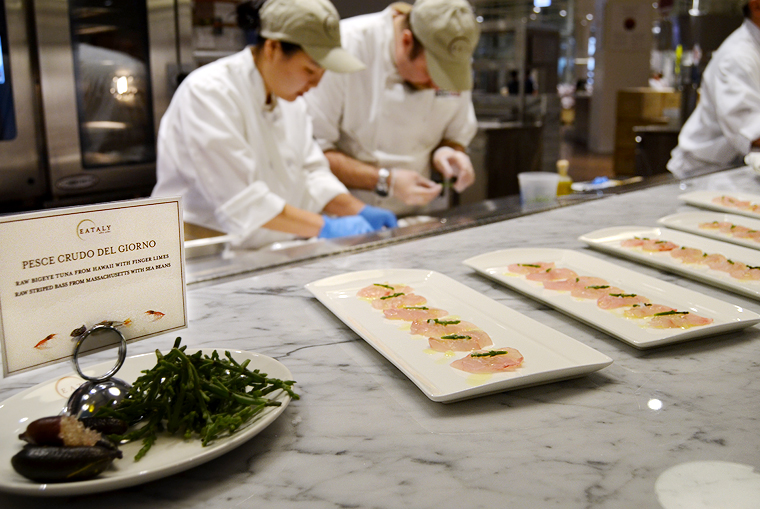
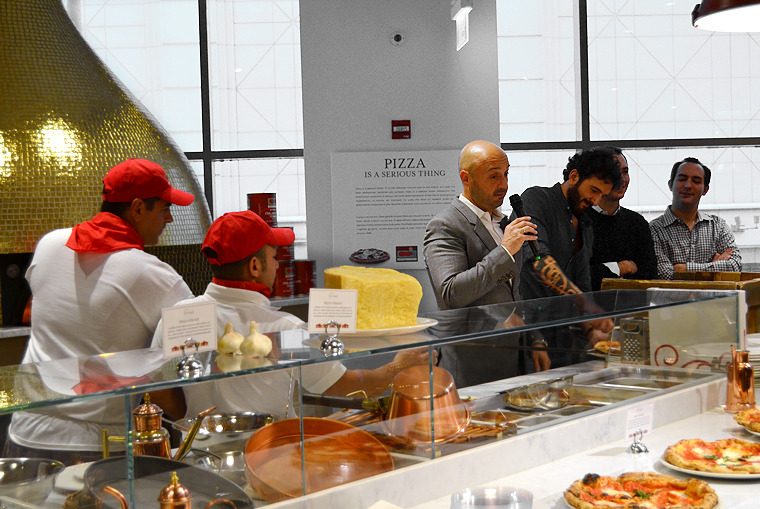
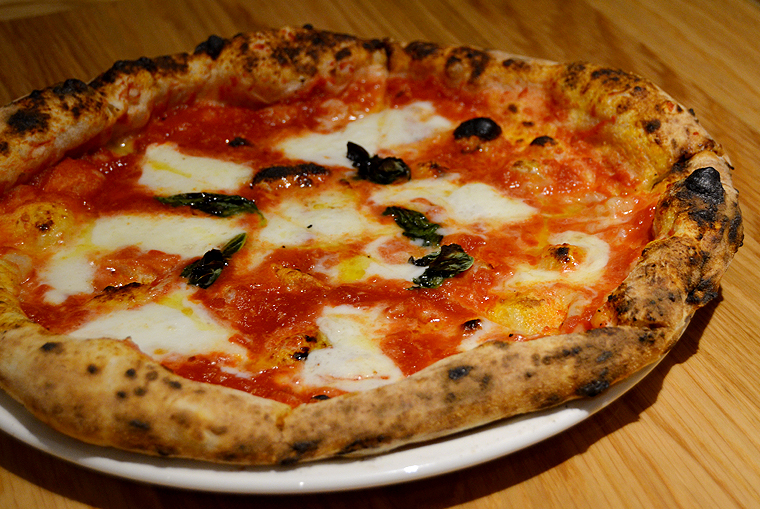
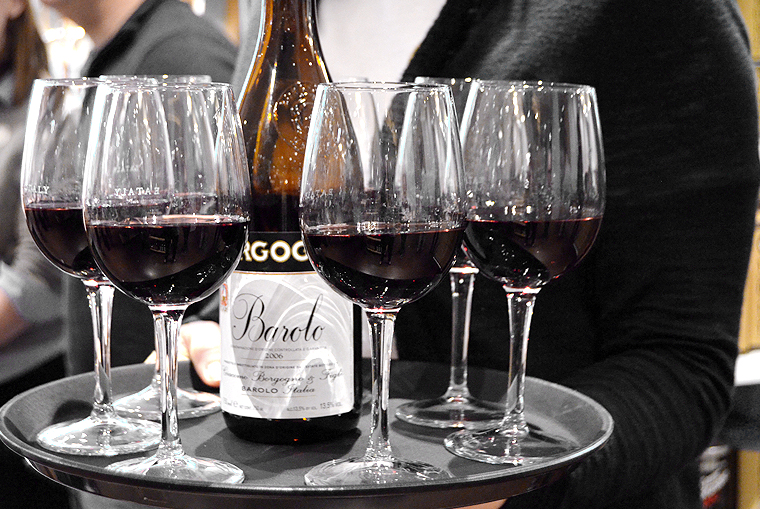
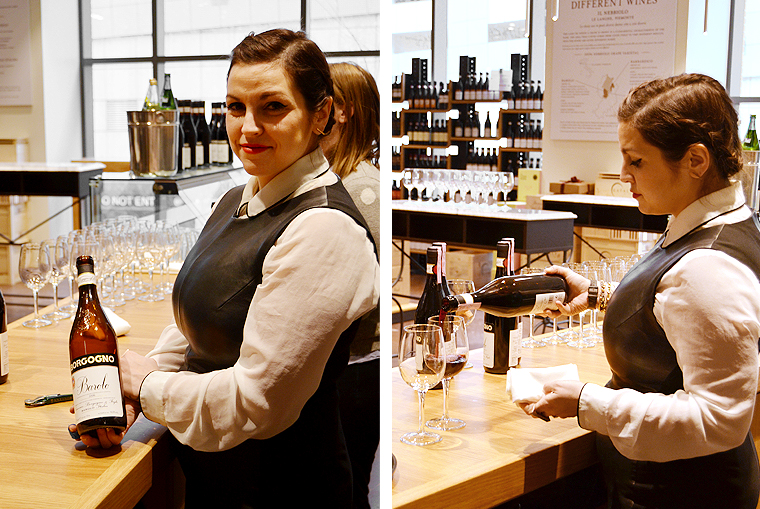
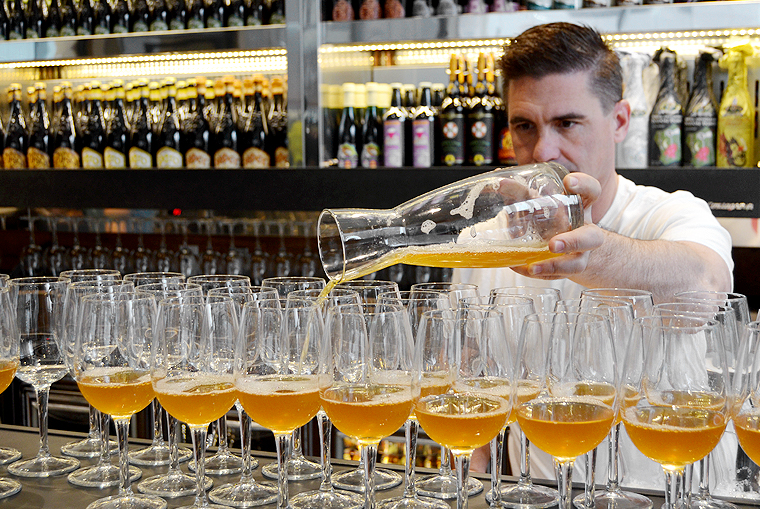
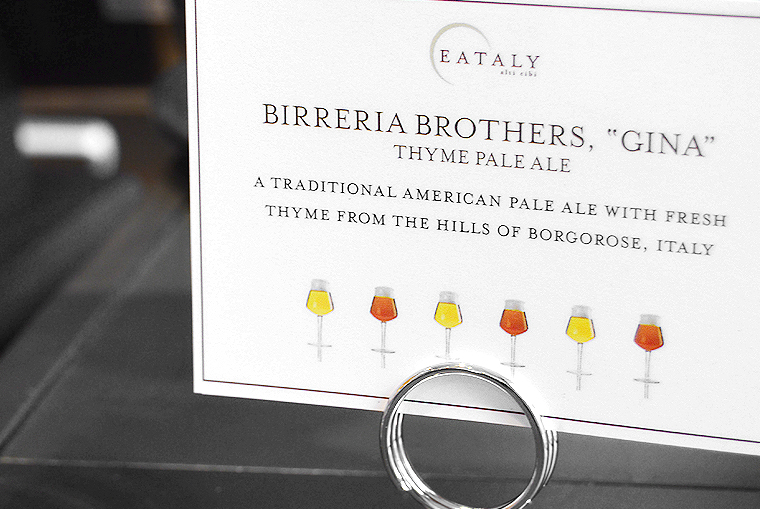
eataly_19There are 23 eateries throughout Eataly to accommodate every taste; at the Fritto bar (Italian fried foods) you can enjoy traditional Roman Arancini, fried calamari, and breaded vegetables. A pizza bar that specializes in not New York pizza, not Chicago pizza, but real, authentic Napoli pizza. Every fresh, hand-made pizza bakes in the wood-burning oven in just 90 seconds. There are also specialty meat, fish, vegetable and pasta eateries, not to mention a fine-dining restaurant. And be sure not to miss the Birrieria, Eataly’s own brewery for a glass of traditional or specialty Italian style beer. I especially enjoyed the Vino bar offering kegged Italian varietals and some of the best wines of Italy ready to savor. I had the opportunity to sample a few of them; the outstanding Barolo was my favorite. At Eataly, guests are encouraged to enjoy a glass of wine as they shop, and you will find pairing suggestions at each of the specialty counters. And the by-the-glass wine selection offers 50 to 60 wines which change weekly!

eataly_35

eataly_fish
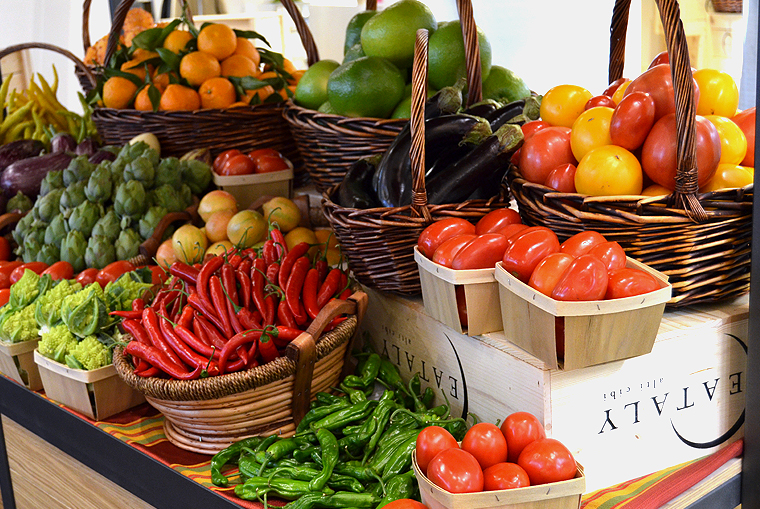
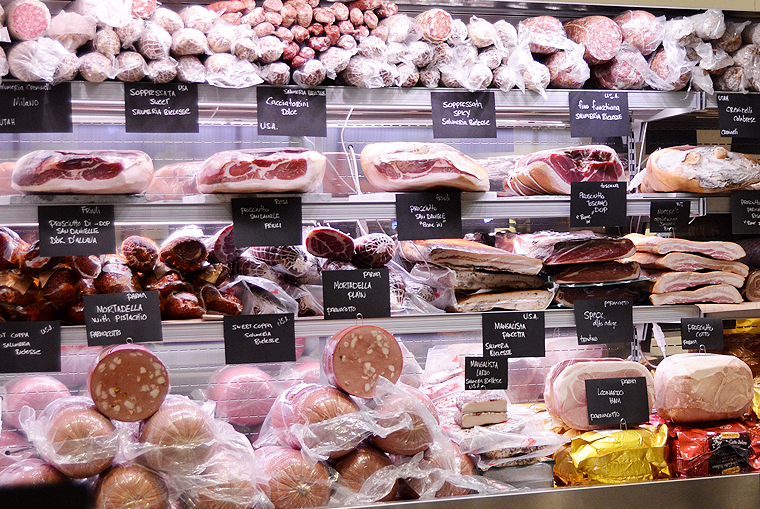
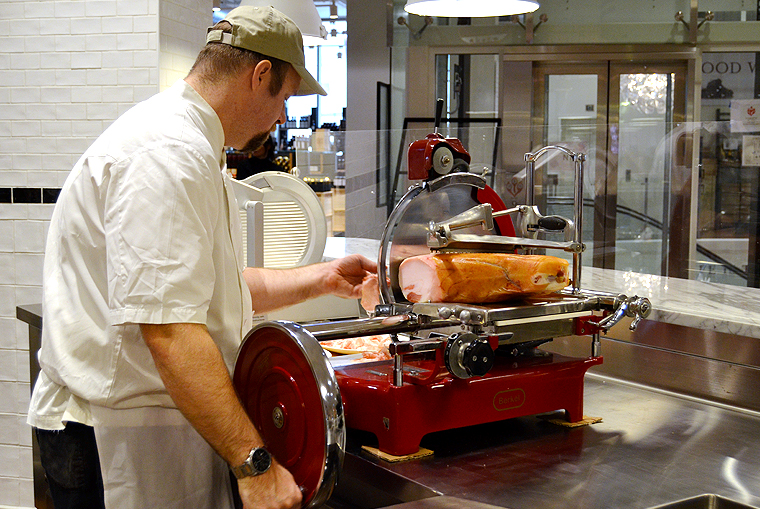
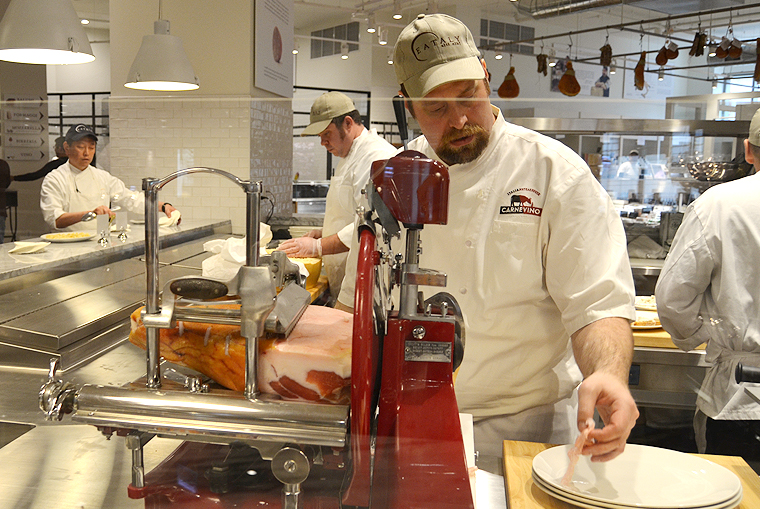
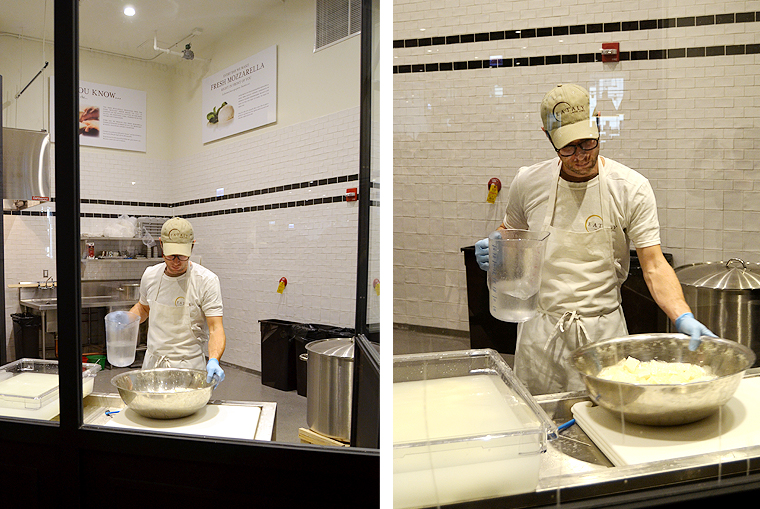
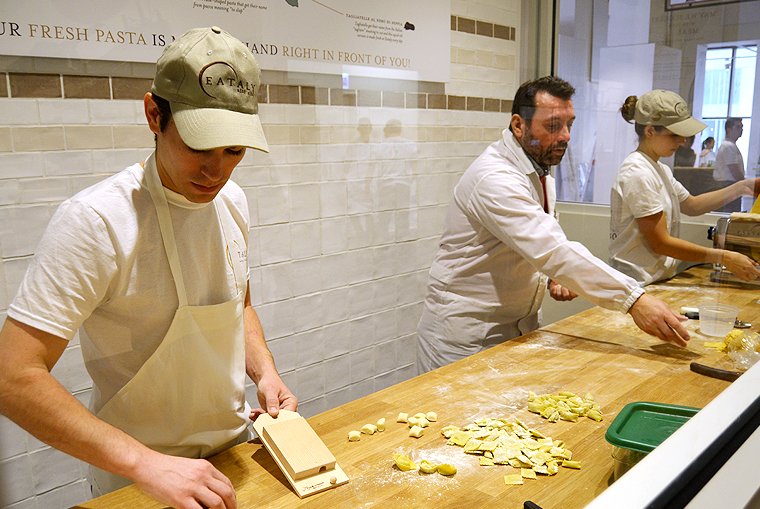
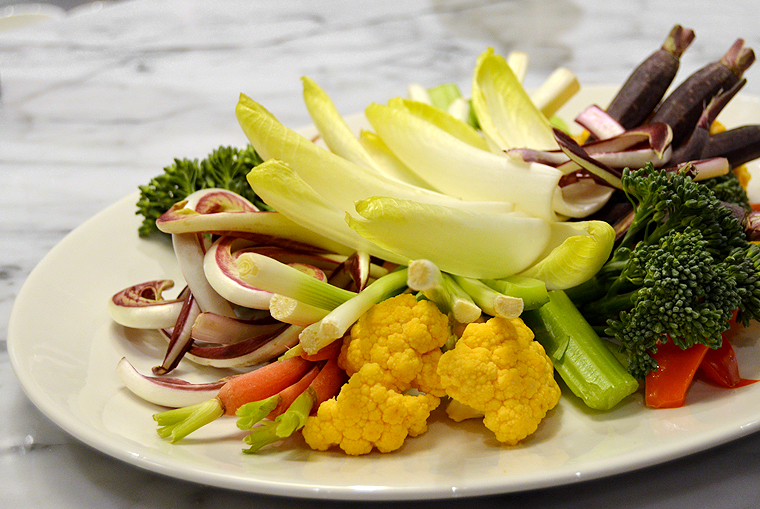
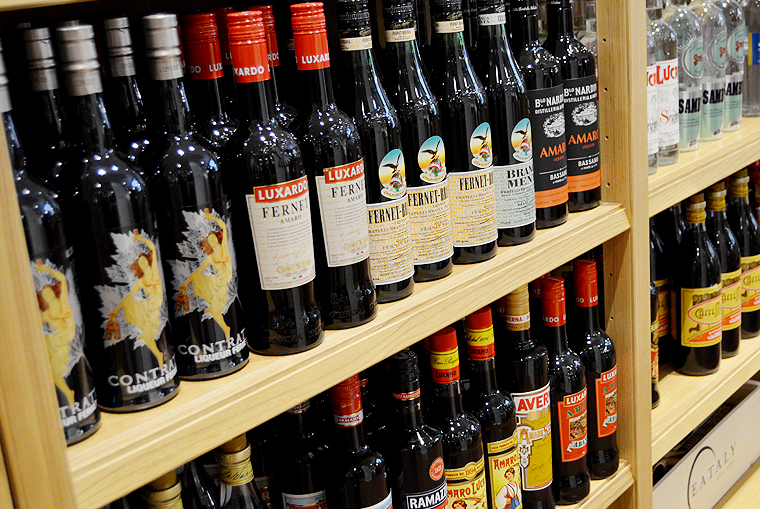
eataly_28eataly_37 eataly_11eataly_12eataly_29It is interesting to note that at Eataly, you will find everything arranged as in a Concerto with mini-restaurants integrated among the various food counters. Have you ever said “Wow, this tortellini is delicious! I wish I knew where I could find it!” That’s the beauty of Eataly. Everything you enjoy is available just a few steps away, from hand-squeezed mozzarella to Prosciutto di Parma or San Daniele from Salumeria Rosi and prosciutto cotto from Parmacotto; they are located just steps away from Piazza (a standup bar) that nicely pairs these ingredients together. Next to the fresh pasta, there is a pasta eatery. And with a mixture of local and imported ingredients throughout the store you are able to find exactly what you are looking for and much more.

eataly_40

eataly_41

eataly_38

eataly_39

eataly_34

The fine dining restaurant, Baffo, is set to open on December 10th and it will be similar to Batali’s New York City eatery, Babbo, offering seasonal food and an extensive wine list. Think this store is “too gourmet”? Not sure how to use the products or ingredients? Don’t have much experience cooking? Not a problem! Classes on technique and guest lectures on wine, beer, and pasta will teach people the history of their foods and how to prepare and serve them! They will also demonstrate recipes assembled entirely from Eataly’s stock. So, write it on a post-it note and stick it to your monitor, or note it in your calendar; just don’t miss the opening of Eataly on Monday, December 2 at 4pm, at 42 E. Ohio street. By the way, Mario highly recommends the Cacio e Pepe (spaghetti with black pepper and Pecorino Romano cheese), in case you have trouble deciding where to start.
eataly_42

eataly_47

eataly_44

eataly_32

eataly_33

eataly_31

eataly_43

eataly_30

eataly_3

eataly_2

eataly_4

eataly_26

eataly_14

eataly_8

eataly_7

eataly_6

eataly_5

eataly_10

eataly_9

eataly_49

Interview with Chef David Dworshak of Takito Kitchen in Wicker Park, Chicago

Takito_Chef David Dworshak Headshot 2

Executive Chef/Partner David Dworshak isn’t new to Latin cuisine. He cooked at Carnivale in Chicago for 8 years;
as Executive Chef for six of those. After having finely honed his craft, Chef David decided to downscale from the massive operation at Carnivale to a more intimate setting, and Takito Kitchen opened its doors in March 20th of 2013.

Recently I sat down with Chef Dworshak to discuss the concept of Takito Kitchen, and what sets his menu apart
from other taquerias in the area. Here are his thoughts.

Q. Describe your cooking style in three words.
A. Local, adventurous, and chignon!

Q. Who are your culinary influences?
A. Mark Mendez, who was my mentor for ten years, and Shawn McClain

Q. Where did the name Takito come from?
A. Takito Kitchen’s name is a phonetic variant of “taquito”. Partner/owner Mario Ponce said he thought it would be fun to spell it as it sounds.

Q. Is there a process you go through to come up with new recipes?
A. Start with seasonal produce, and traditional recipes and then go from there. Sometimes I take traditional recipes and do a spin on those as well.

Q. You are a big fan of what you call “the magic bite”, where you experience all the different flavors and textures of a dish all at once. What is the one dish at Takito Kitchen that represents your most magical bite?
A. New Roasted Winter Squash with Three Sisters Polenta
CC. (A Cook’s Canvas) Agreed. And YUM!

Q. Name three dish at Takito Kitchen a new diner shouldn’t miss.
A. Bass Ceviche, Lamb Chorizo taco, and Fish Taco.

Q. What are your most and least favorite ingredients to work with?
A. Most: Chilies, Peppers, and Black Garlic.
Least: Caraway seeds strong Anise flavors. I believe Anise has it’s place in some recipes.

Q. Briefly describe what a typical day is like for you at the restaurant.
A. It starts with prepping for lunch/brunch. Then a staff lunch and shortly after a line setup for lunch and brunch. Next prepping for dinner and have a staff dinner before the crowd. Close down, order quality ingredients and products and repeat the next day.

Q. Besides Takito Kitchen what restaurants do you like to eat at in Chicago?
A. Small Bar, Cemitas Puebla, and Spoon Thai Eatery

Q. What excites you most about the Chicago food scene?
A. The dynamic world of food culture that is present, along with the high quality food products available here.

Q. What do you cook for dinner at home?
A. Something light and healthy. Perhaps a bowl of noodles.

Q. Do you have a guilty pleasure; something you eat when nobody is looking?
A. Dark chocolate

Q. There are many home cooks out there like myself who are not beginners but haven’t yet reached the professional level; so I’m wondering what advice you would give us to take our cooking to the next level?
A. The home chef has an advantage over professionals; they have the time to practice a recipe over and over until it’s perfect. Cook it over and over as many times as it takes until you have a perfect dish, then throw dinner parties. Also, be wary of some cooking shows, they can be misleading. I can highly recommend watching The Mind Of A Chef. This season it is hosted by Sean Brock and April Bloomfield.

Takito Kitchen, Chicago

tk_entry3

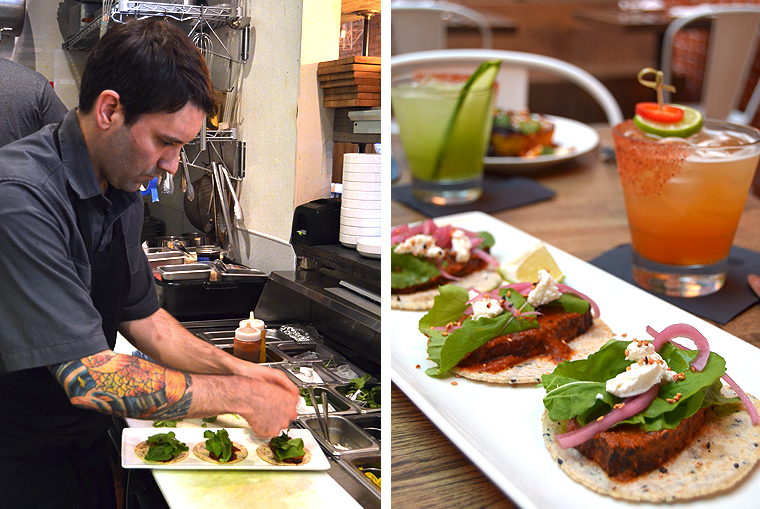
There are tacos and then there are tacos.  Executive Chef/Partner David Dworshak (formerly of Carnivale, and Spring) of Takito Kitchen has created a delightful menu with a modern-contemporary spin on Latin-American cuisine. Takito Kitchen’s name is a phonetic version of “taquito”, Spanish for little taco. This Wicker Park restaurant is warm and cozy with a modern flair. Chef David’s menu features seasonally inspired shared plates; ceviche, tacos, soups and more with a focus on fresh ingredients and complex flavors, all tucked inside fantastic housemade tortillas. The dishes at Takito Kitchen are seasonal and support local farmers and producers; Chef David is very active at the Green City Market, sourcing as many local ingredients as he can, tailoring his menu to maximize use of the freshest produce available. The plates are intended for sharing and tend toward a more creative, healthier style of Latin-American food. I recently had the opportunity to dine at Takito Kitchen, and talk with Chef Dworshak. When asked about the concept of the restaurant, Chef David said that their goal is to raise the bar of what a taqueria is by turning out contemporary interpretations of traditional Mexican/Latin American dishes. The results are a fresh perspective on taco culture served alongside intriguing, handcrafted cocktails by well-known Chicago mixologist David Weber.

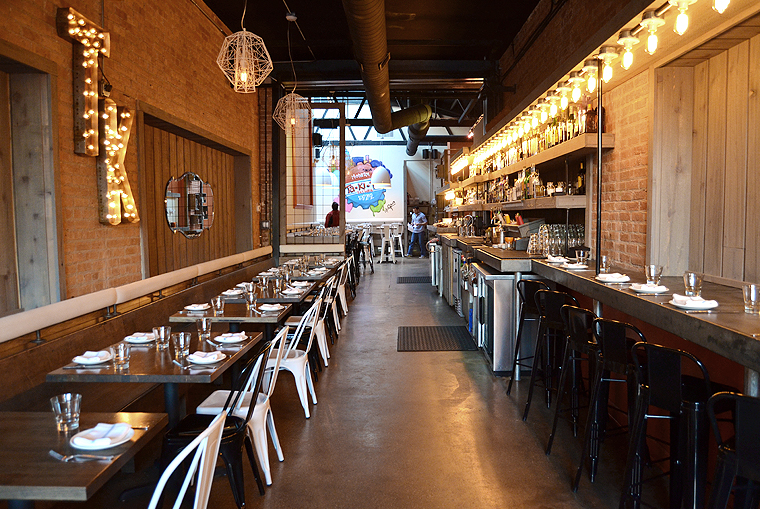
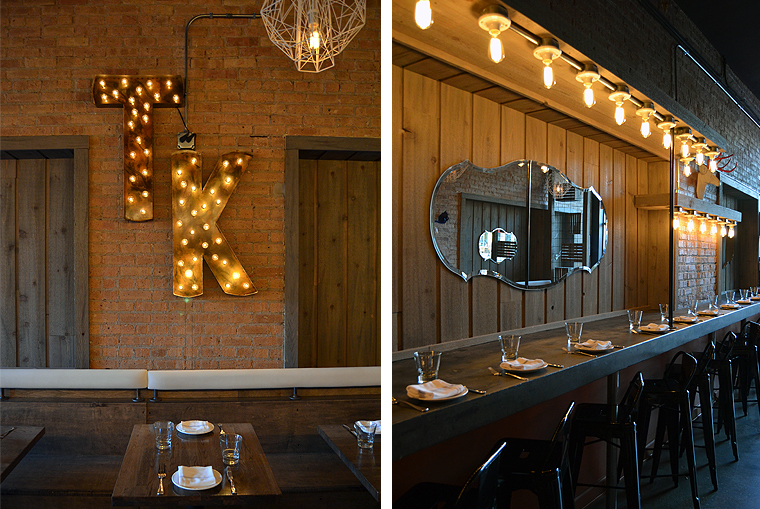
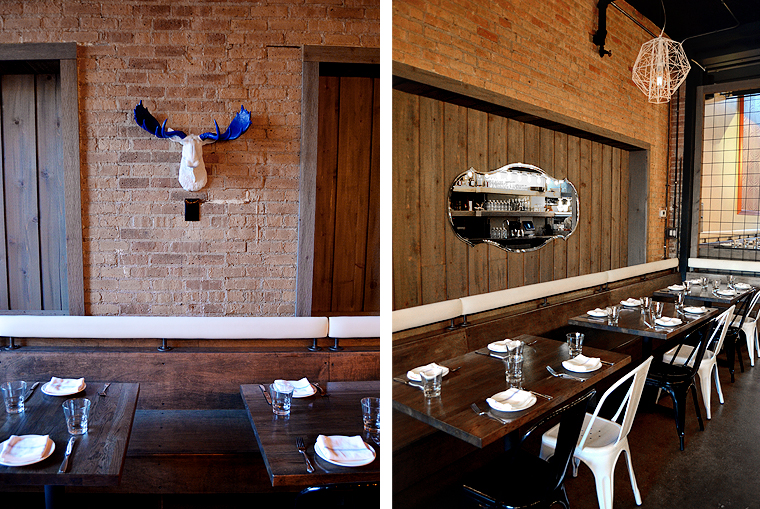
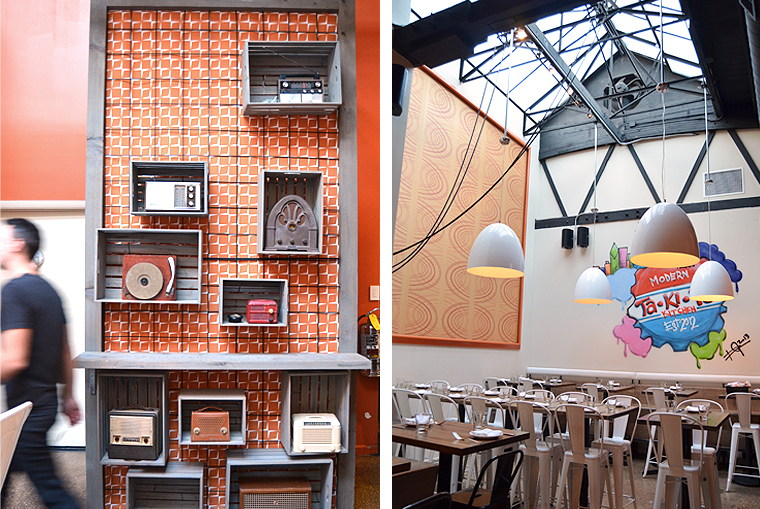
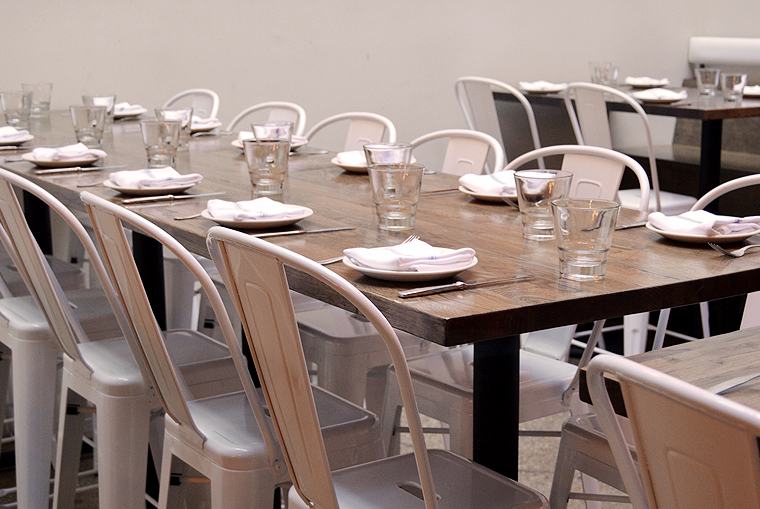
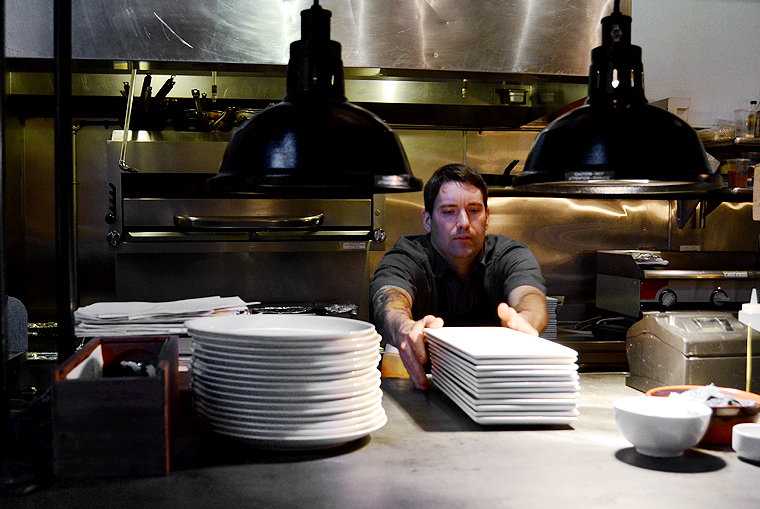
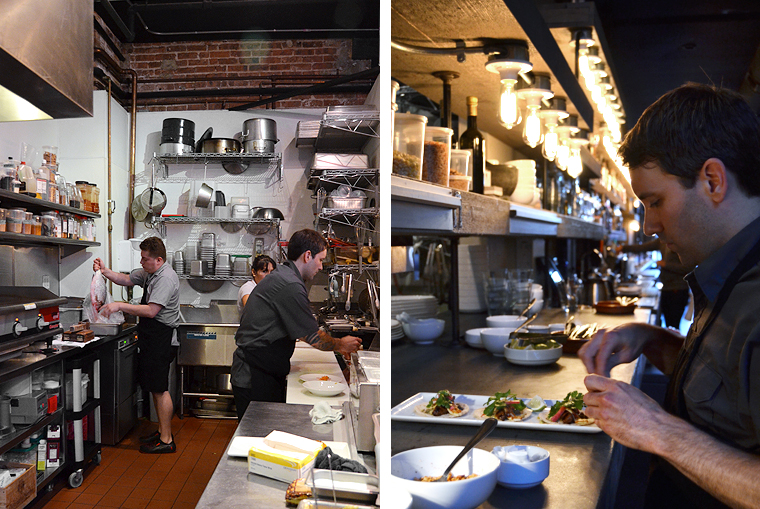
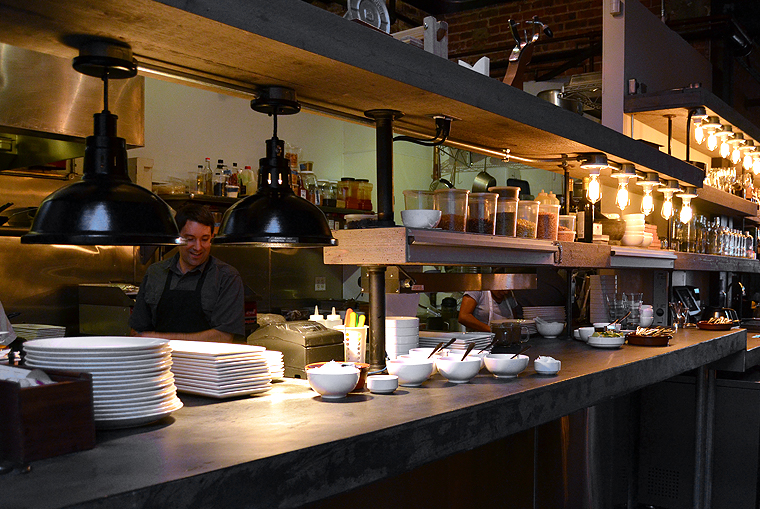
The space is long and narrow, with a row of glowing edison bulbs leading you on like a runway to the skylighted atrium at the rear. The tables you pass along the way, normally filled with diners, are constructed of warm natural wood surfaces, rows of pendant lights and eclectic urban artwork lining the walls. Seating 80 patrons, the exposed brick walls and saloon-style mirrors expand the visual space, and the open bar and kitchen areas and natural lighting set the stage for a fantastic dining experience. The stone counters in the prep area lend a very precise feel to the presentation, and frame your view of the kitchen, which is remarkable in its efficient use of space.  To see 4 and 5 chefs working in choreographed rhythm in such a confined area, with nary a bumped elbow, is remarkable. tk_entry

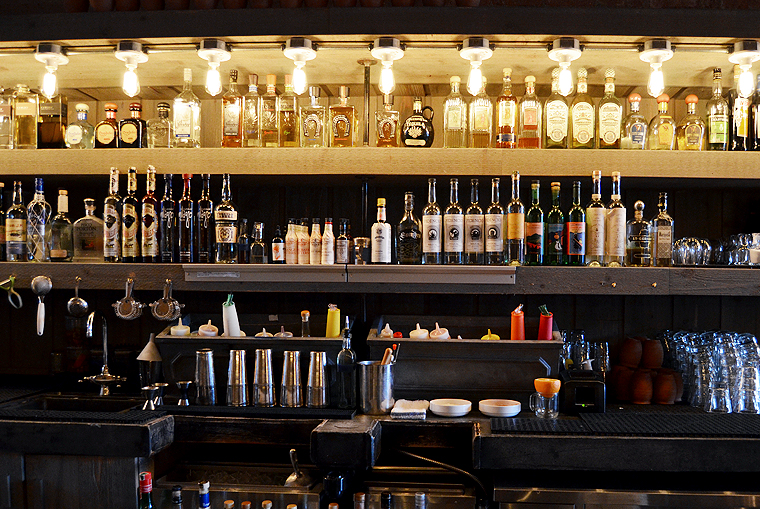
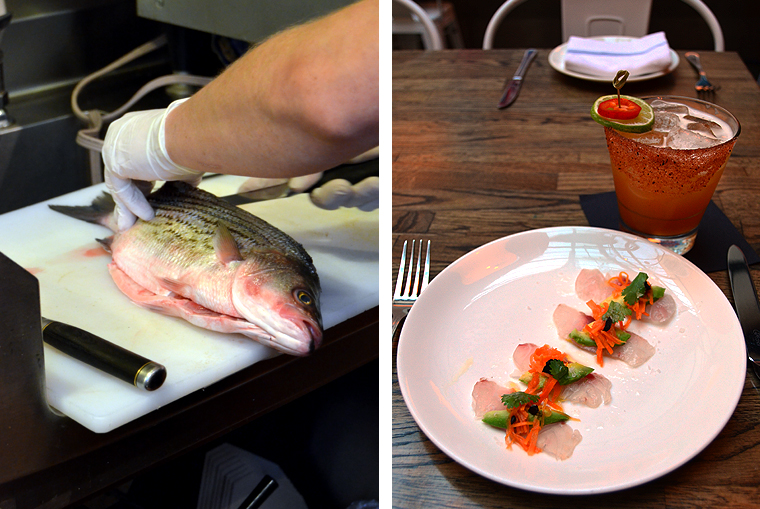
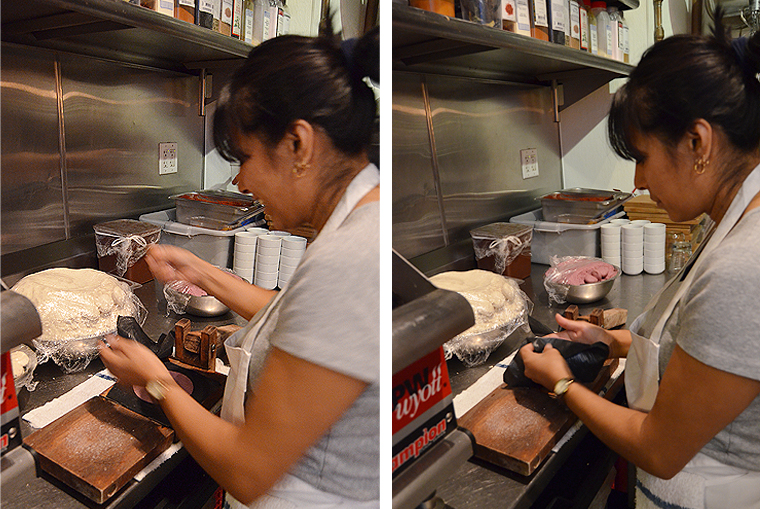
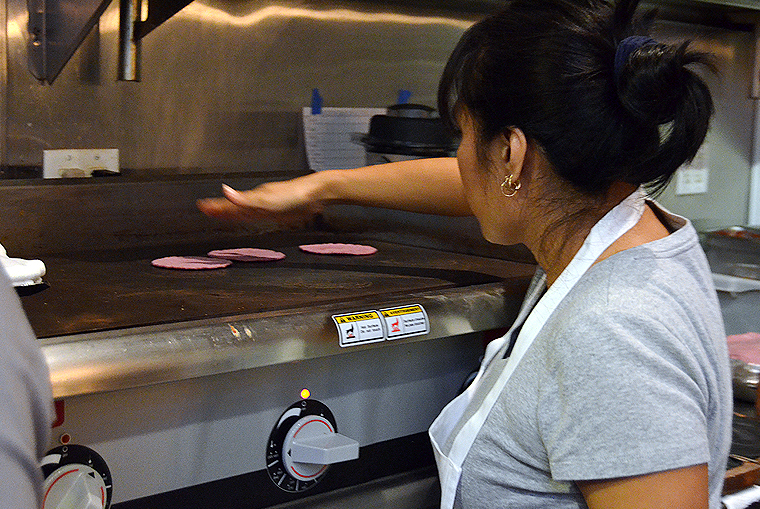
tk_entry2Further forward is a long bar area where the bartender skillfully prepares drinks, becoming part of the dining experience, then whisked to your table the moment they are ready. Its a nice alternative to the usual hurried rush of shakers behind a bar across the room. For my photography work, I chose a table in the open skylight area because it is bathed in natural light. I watch the kitchen staff while waiting for my meal as one of the cooks prepares hand-made tortillas, the heavy fragrance of maize filling the air as they grill while another cook skillfully fillets a whole fish into delicately sliced ceviche. The intimate space and thoughtful layout provide ample opportunity for the Chef to interact with guests, heightening the dining experience with his insights about the menu.tk_bar

tk_backdiningarea2

tk_backdiningarea

tk_kitchen3I first had the pleasure of tasting Chef David’s work at Chicago Gourmet this past September. He had prepared a delicious braised pork topped with charred corn atop a creamy polenta. I don’t often go back for seconds at these events, but the pork was so fantastic I had to tell the Chef how delicious it was.

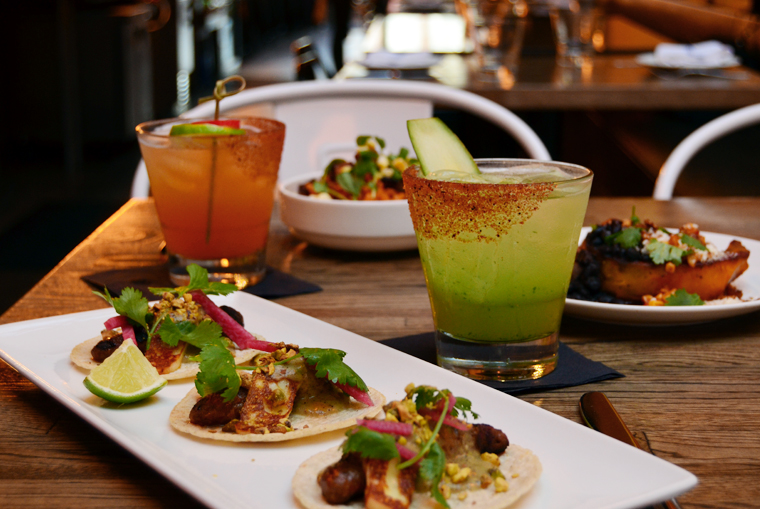
The first to arrive was a shared plate

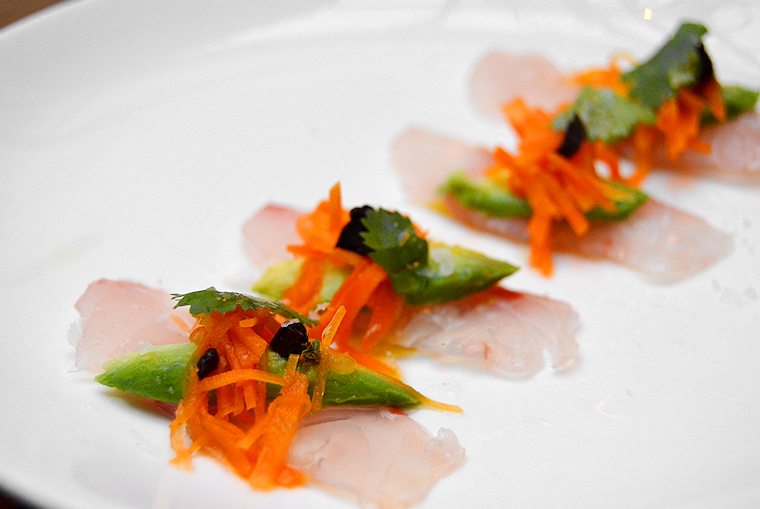
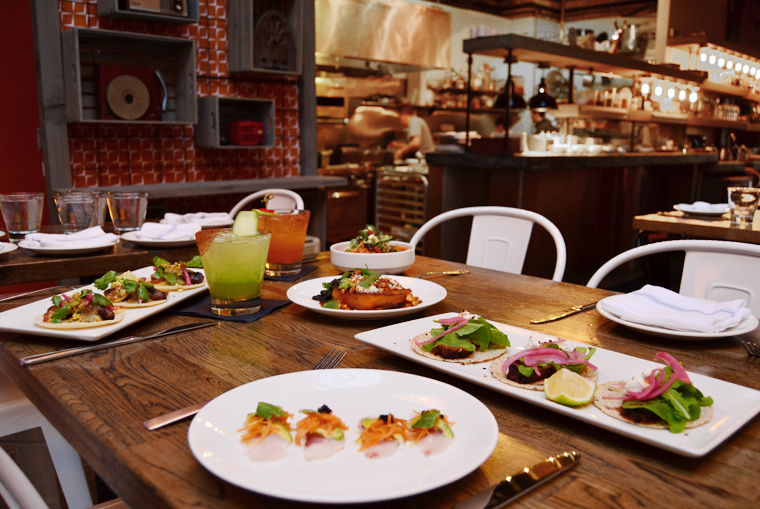
Suzuki Bass Ceviche with spiced carrots, black garlic, Urban Till cilantro, and lime
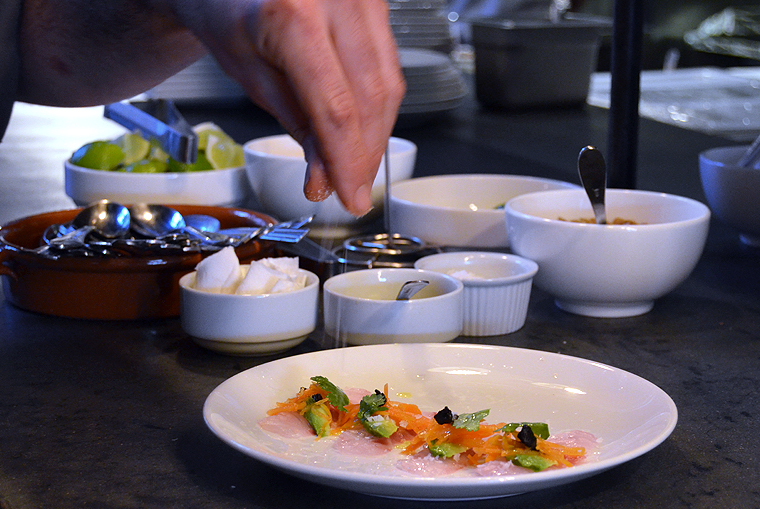
After watching one of the cooks preparing the ceviche from a fresh sea bass, I was eager to try this dish. The fish was fresh and delicately flavored, enhanced by the earthy sweet flavor of black garlic and a little spice from the pickled carrot. Refreshed with lime juice and olive oil, and topped with sliced avocado and fresh turmeric, this was a very nice way to enjoy raw fish, adding to its simple texture and flavor without covering it up. I could eat this dish every day.
tk_bass2

tk_prep2

tk_bass

Then there were tacos

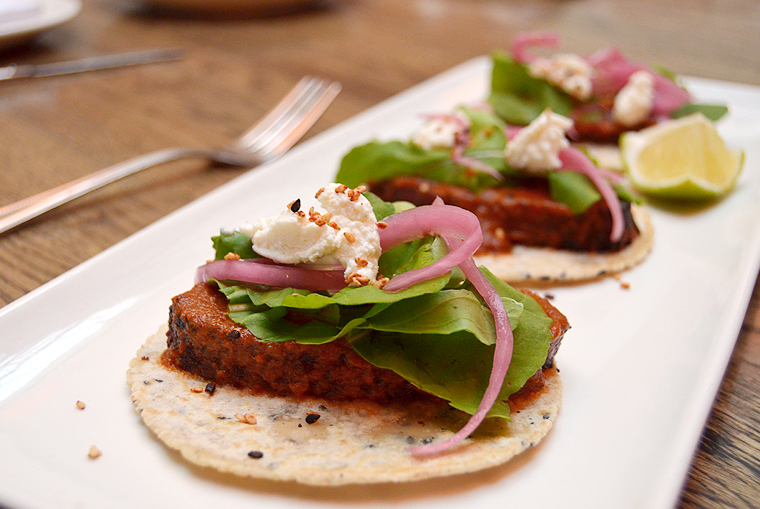
Pork belly taco with pickled onions, morita salsa, mozzarella, arugula on a sesame tortilla
C’mon, I mean it’s pork belly! What’s not to like? The crispy pork belly was rich and savory, not overly smoky, and not the least bit greasy, and topped with fresh mozzarella, morita salsa, pickled onions and local arugula. Just spicy enough to be interesting and the pickled onions were a surprising touch, adding some acidity, balancing the richness of the pork belly.
tk_porkbellytaco2

tk_prep

tk_porkbellytaco
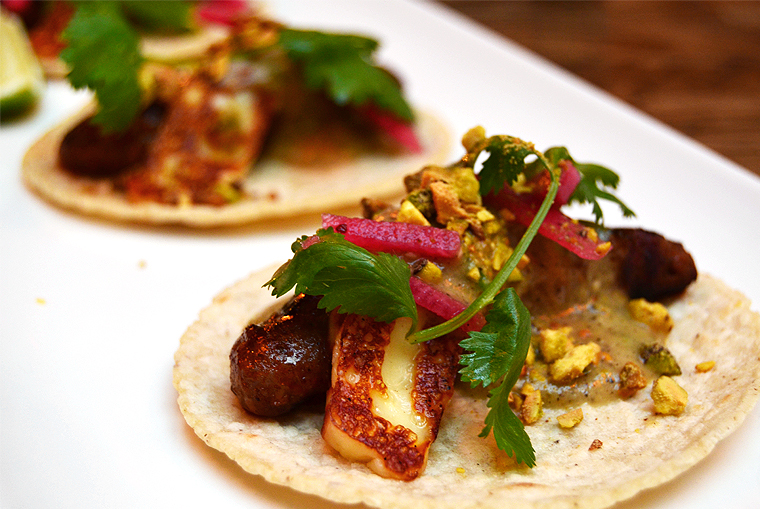
Lamb chorizo taco with tomatillo pistachio salsa, jicama escabeche, Brunkow cheese on a corn tortilla 

These hand-rolled uncased sausages are prepared with freshly ground lamb seasoned with morita chilis, paprika, and cumin, rolled and grilled then served on a warm corn tortilla topped with jicama escabeche, tomatillo pistachio salsa, and a grilled strip of Scandinavian-style Brun-uusto cheese from Wisconsin’s Brunkow cheesemakers.
tk_lambchorizo2

tk_lambchorizo

tk_housemadetortillas

tk_housemadetortillas2
Next, a couple more sides/shared plates

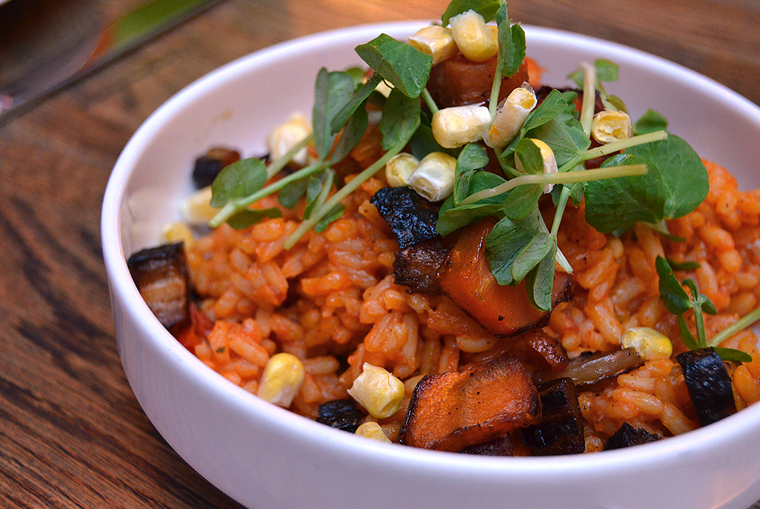
Smoked tomato rice with charred carrots, pea shoots, and corn
Charred carrots, dehydrated corn, carmelized onions, nutty micro-greens, and pea shoots add depth and dimension, elevating this common side to something worth writing about.
tk_tomatorice

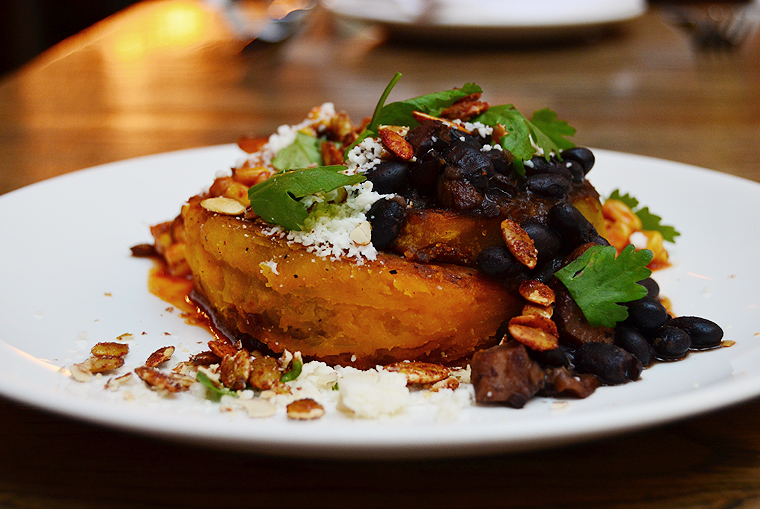
Roasted winter squash with black beans, smoked belly, corn kimchi, pepitas and cilantro 
This meal is ideal with cooler fall temperatures. The squash is hearty and meaty even though there is only a touch of smoked belly in it, the meatiness comes from the thick slices of winter squash. The corn kimchi is a wonderful addition adding a spicy, acidic touch! Arrives topped with black beans, pepitas, and Urban Till cilantro.
tk_wintersquash

Dessert

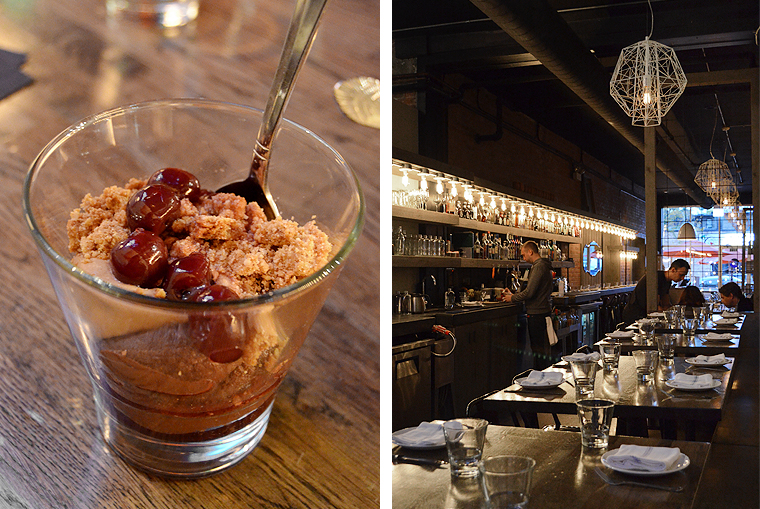
Mexican chocolate ganache with coffee creme, brandied cherries and an almond masa crisp.
The coffee creme is light, creamy and not overly sweetened. The Mexican chocolate is flavored with ginger, allspice, and the added punch of the brandied cherries. The sophisticated layers of flavor make this a dessert you shouldn’t pass up.
tk_chocolateganache

The drinks

The Beverage Manager/Partner/Mixologist Adam Weber (of Trenchermen, Mercadito) has certainly made a name for himself in Chicago’s rapidly changing the world of bartending. Weber has crafted the perfect custom cocktails to go with the fresh, sophisticated menu at Takito Kitchen, rounding out a fantastic dining experience.

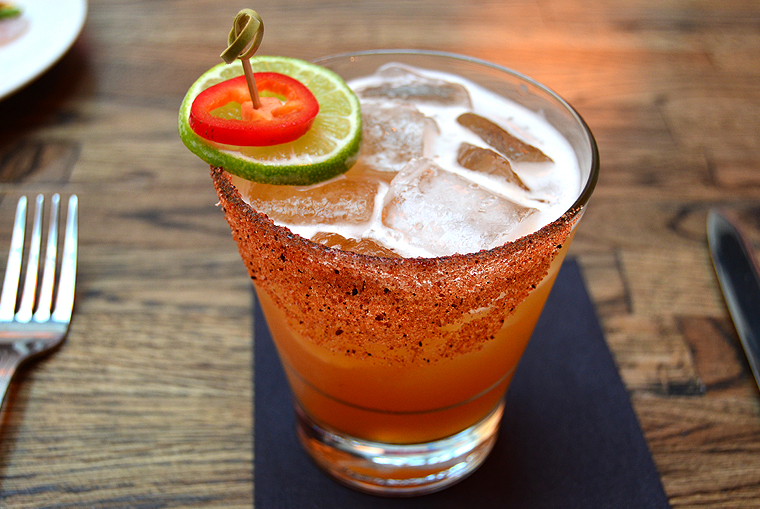
Caliente Margarita with lime, agave, chipotle, morita, Cointreau, and Corazón Blanco
Amazing. I can assure you, you have never had a margarita like this. It’s a spicy, acidic and wonderfully complex concoction. With the sweetness of lime, agave, and Cointreau, and the smokiness from the chiptole and morita chili-spiked rimming salt, you won’t find a better margarita. I had a hard time resisting the temptation to order up another!
tk_calientemargarita

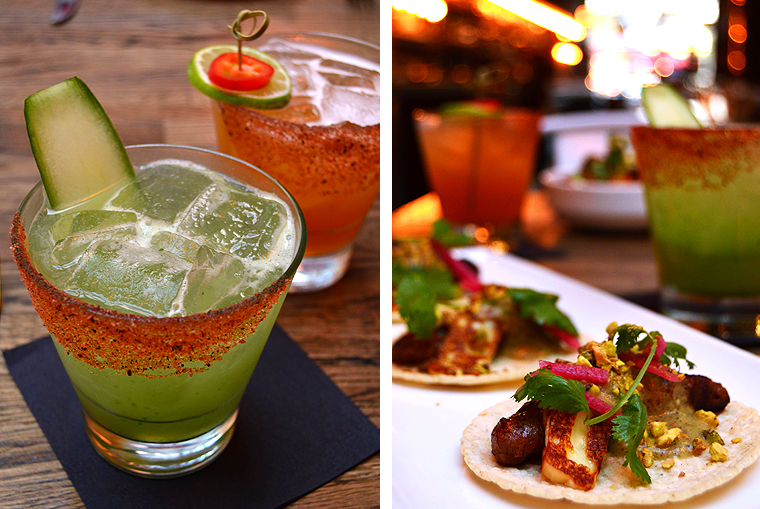
Cucumber Margarita with lime, agave, cucumber, Cointreau, and Corazón Blanco
The cucumber margarita is light, refreshing and smooth, with a surprising richness that I didn’t expect from Cucumbers, and the chili dusted, salted rim makes it easy to empty the glass before your plate is empty. I didn’t know what to expect of a cucumber margarita, but this was a really great drink that soothes the palate while enjoying a spicy meal.
tk_lambchorizo3

Takito Kitchen answers the question, does Wicker Park really need another taco joint? with a resounding Si! It doesn’t matter if you are a casual taco fan or a true taco aficionado, Takito serves up a fresh variety of flavor combinations you’ve never tasted before, and at a level of sophistication that is hard to find elsewhere in the Chicago taco scene. Chef David and his fantastic staff have taken the taco to places it has never been before, on artisanal tortilla wings.
tk_kitchen1

tk_diningexp

Interview with Chef John Coletta of Quartino Ristorante in downtown Chicago

John_HS


“Where wine is cheaper than water.” – Quartino Ristorante

Recently I had the pleasure of sitting down with Chef John Coletta, the founder, managing partner, and Executive Chef of Quartino Ristorante & Wine Bar in Chicago, and asked him a few questioned tailored to take a peek beyond his official bio at the man behind the accolades.

From his official bio:

John Coletta, a first generation Italian-American, is a chef, restaurateur, author and respected veteran in the Chicago and International culinary communities. As Executive Chef and Managing Partner of Quartino Ristorante & Wine Bar, Chef John preserves the authenticity of regional Italian cuisine, through honed culinary techniques and authentic Italian ingredients.

The son of Italian immigrants – former owners of a neighborhood restaurant – John acquired a deep respect for food and an appreciation for La Vera Cucina Italiana at a very young age. John’s summers spent in central and southern Italy also cultivated his interest in Italian gastronomy and culture. While spending time in Italia, the concept that meals were the most important part of the day made it obvious to Chef John what his career path would be, “It was a natural evolution for me to become a chef” he recalls.
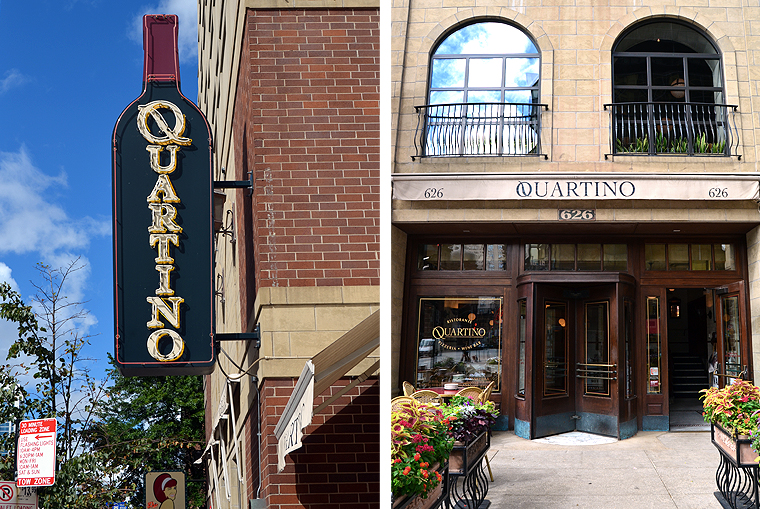
quartino_outside1His resume and list of accolades is extensive:

With his degree in hotel and restaurant management from New York City Technical College, he spent his formative years training with the finest European chefs. He worked at the legendary St. Regis Hotel and Waldorf Astoria Hotel, the Four Seasons restaurant and Le Coup de Fusil, earning his stripes as an apprentice to revered chefs such as Arno Schmidt, Seppi Renggli, Yannick Cam, and Andre Rene. He trained under Alain Ducasse at Louis XV in Monte Carlo, Joel Robuchon in Paris and Three-Star Michelin chefs Pierre Wynants and Pierre Romeyer in Brussels, Belgium.

His first foray into commanding a kitchen of his own as Executive Chef, John earned a Four-Star award from Mobil for his work at Nikolai’s Roof of the Hilton Atlanta. He then went on to reign over an army of 450 cooks in ten different restaurants at Caesar’s Palace in Las Vegas. He was proclaimed one of the four “big guns” of Asian hotel cuisine by the Sydney Morning Herald, while serving at the five-star Shangri-La Hotel in Singapore. An individual gold medalist in the 1984 culinary olympics, and won another gold medal in Frankfurt, Germany in 1992 as part of the Culinary Olympic Team USA. He earned a title as one of America’s Rising Star Chefs by PBS television. He advised the 1994 USA team at the Culinary World Cup in Luxembourg, which earned first place among competitors from around the globe. At the 1997 Epcot International Food and Wine Festival, Chef Coletta shared billing with the likes of Julia Child and Paul Bocuse as part of the Visiting Masters From the World of Food.

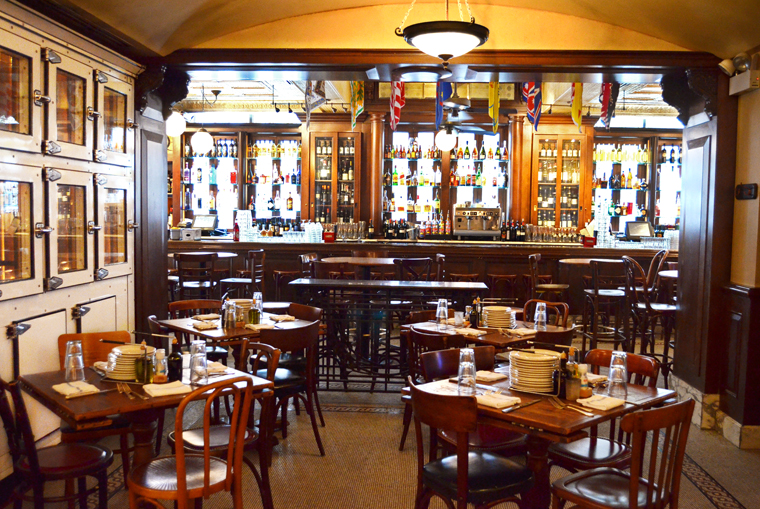
A native New Yorker, John’s migration to the city of broad shoulders offered him the chance to join the ranks of Chicago’s top chefs. Opening Entro Nois and Primavera at the Fairmont Hotel and the acclaimed Caliterra restaurant in Chicago’s Streeterville neighborhood as Executive Chef lead to his most promising endeavor. In 2004, John embarked on a partnership with Steve Lombardo and Larry Shane to realize his vision of a classic, urban-Italian ristorante. John infused Quartino Ristorante & Wine Bar’s seasonally-driven menu with authentic regional preparations of rustic Italian recipes – many of which date back more than 200 years. His preparations of house-cured and aged Salumi, such as Sopressata, Salamette Pancetta and Duck Prosciutto, along with cheeses made daily in-house, are a nod to John’s love and respect for La Vera Cucina Italiana. In short, with the creation of Quartino’s menu, John stayed true to the same culinary philosophy that he has held since the beginning of his career: Prepare Italian food with Italian passion.quartino_dining room
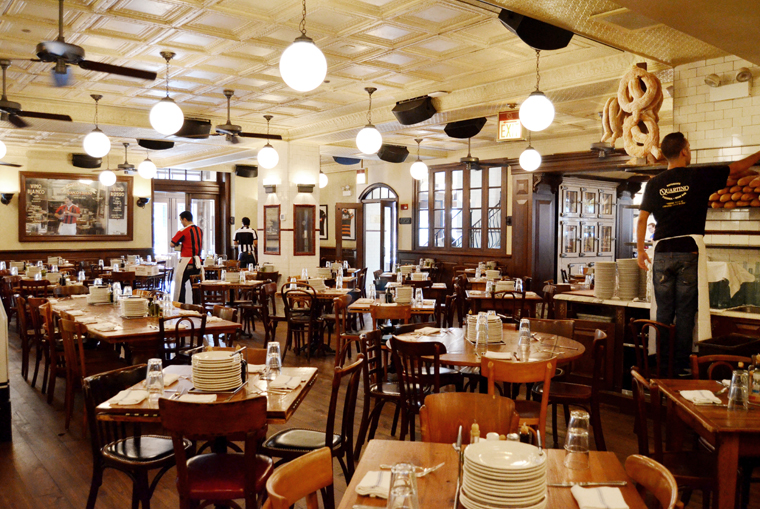
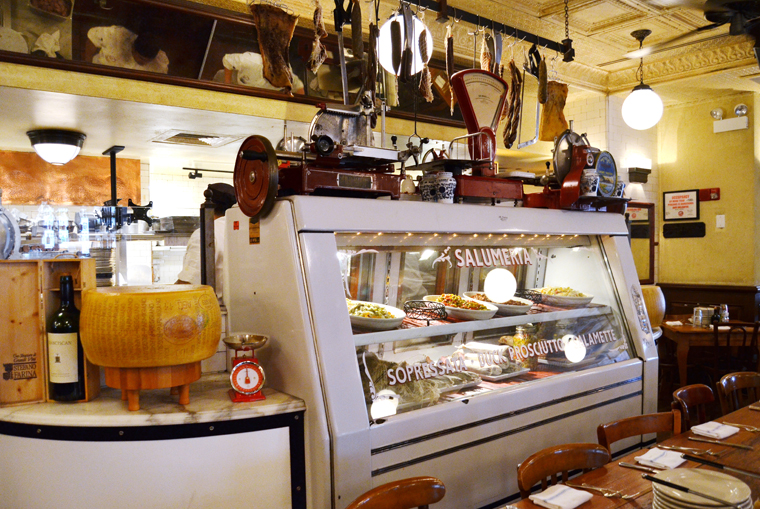
quartino_salumeriaQuartino opened its doors in December of 2005 and is now entering its eighth year of showcasing the flavors and traditions of Italia’s most vibrant regions to Chicago diners. Quartino is the recipient of the coveted Ospitalita Italiana, which is awarded by the Italian government and recognizes restaurants which uphold the traditions of Italian culture.

In 2005 Chef Coletta authored and published 250 True Italian Pasta Dishes, a cookbook dedicated to his passion for La Vera Cucina Italiana. A passion for authentic Italian products has lead Chef Coletta to be the national spokesperson for Carmelina Pomodori e Polselli Farina, a true expression of Alimentare Italiane.

Chef Coletta saw and continues to visualize Quartino as the ideal vehicle for synthesizing the insights derived from his childhood immersion in Italian cooking and his classical training. Coletta strives daily to continue achieving his goal to, “Honor humble authentic Italian dishes and present them as they are meant to be experienced.”
quartino_interior1

quartino_interior0

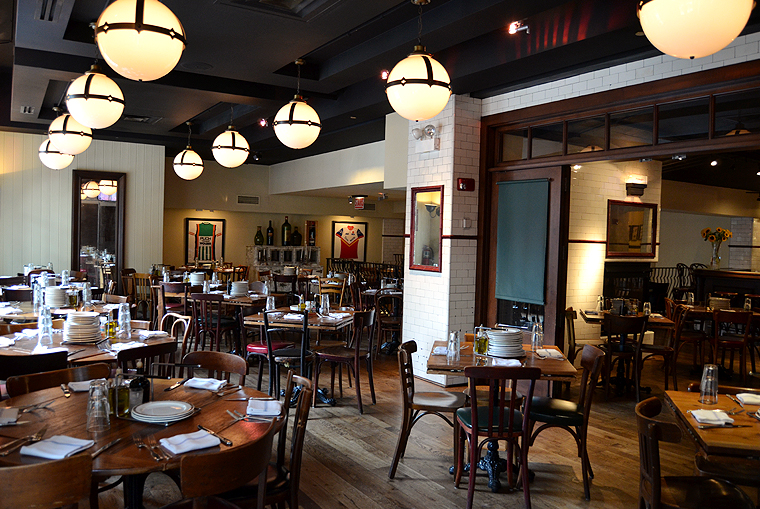
acookscanvas-dining_bar-copyright2012-2013_4The moment you step into Quartino, you are immersed in the vision of Chef Coletta, and if you are in luck he will stop at your table to ask how you are enjoying your meal, to which you will respond, full mouthed, that you are enjoying it very much. His impeccable approach to Italian food culture comes through in every bite of marvelous food, and in every inch of his magnificent Ristorante. I rate it an A++ for the uncommon blend of relaxed, friendly atmosphere and rigorously prepared, uncompromisingly authentic Italian cuisine.

Q. Where did the name Quartino come from?
A. Quartino refers to the glass carafe of 250 ml. known in Italian as a Quartino, a quarter liter of wine.

Q. Do you have a favorite dish at Quartino? Why?
A. My favorite preparations vary through the seasons. The preparations which express the inborn natural flavors found in the season’s harvested vegetables, fruits, fish or cheeses served at their optimal flavor point are truly memorable cravings.

Q. How old were you when you started cooking?
A. I began cooking at the age of 15 alongside my father. He then arranged several apprenticeships for me at the St. Regis and Waldorf Astoria Hotels in NYC.

Q. Do you have a specific memory that stands out from being in the kitchen growing up?
A. I have a vivid memory seeming as if it were yesterday!! There was a discussion in the kitchen of the Waldorf Astoria on a Sunday afternoon with a very diverse group of seasoned international chefs who had varying levels of culinary supervisory responsibilities at the Waldorf Astoria. The topic of being able to cook thru varying economic levels. The agreement was that a chef must be able to cook luxury foods in the best of times with precision and expertise, in challenging economic times chefs must be able to prepare foods which are approachable and less celebratory with the same level of enthusiasm, knowledge and focused execution.

Q. What is a standard day for you?
A. A typical day for me begins with a fact finding exercise which involves a full review of yesterday’s events starting with staffing levels and or challenges; food procurement challenges; market challenges; customer challenges; equipment challenges; service challenges; condition of the facility; menu opportunities. This typically takes several hours. The next step is to review; menu preparations; review seasonal opportunities; the day’s upcoming events; weather conditions; meet with our chefs; meet with vendors; interview culinary candidates; meet with customers; meet with managers; and another review of each of the categories mentioned above.

Q. What or who are your influences?
A. I am driven and influenced by the requests and needs of our customers and staff. In the event a customer finds our pasta over or under cooked is terribly concerning to me or the temperature of our fish is improperly stored will greatly affect the experience of our customer and greatly impact the decision of the customer to revisit Quartino. I am obsessed with our customers complete experience.
Q. What is the most essential item in your kitchen?
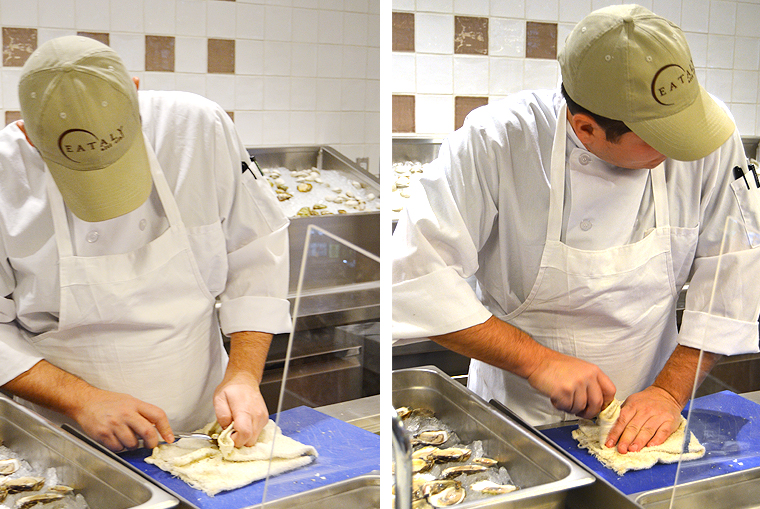
A. There are many essential items in the kitchen. The crucial item is a sharp knife, without it, a dish has little success of being prepared properly.

Q. Is there any one ingredient you hate to work with?
A. I refrain from utilizing inferior raw materials, since the results can never be positive

Q. If you weren’t in the restaurant business, what do you think you’d be doing?
A. This is a great question!! I never really thought or considered doing something else. Food and wine are a consuming subject which require my attention daily.

Q. What do you cook for yourself and your family at home?
A. I enjoy cooking seasonal foods. The results are truly magical and my family and friends believe that I am a superior cook. The fact is that the seasonal ingredient is superior allowing for a noteworthy experience. I believe that 70% of superior cooking is the direct result of having a superior product. The addition of a focused and executed technique represents 30%.

Q. Name three wines you love to drink.
A. I enjoy drinking wines which compliment foods. Therefore, when I select a wine I prefer to drink a wine that is indigenous to the region from which the food preparation hails from. This is very achievable assuming that you are in Italy, France or Europe. This being said and understood, I do have a preference to the wines of Lombardia and Piedmonte.

Q. Other than Quartino, where do you like to eat in Chicago?
A. My first choice is Pelago without a doubt. I also love Spacca Napoli and Piccolo Sogno

Q. If you could have dinner with anyone, who would it be?
A. I enjoy having dinner with my wife Jenifer and our children and my partner Steve Lombardo and his wife.

Q. Where would one find you on your day off?
A. Usually I am visiting a supplier, producer or grower. I also enjoy visiting produce markets.

Q. Are you close to other Chefs from being in business so long? If so, who?
A. My free time is very limited and is usually spent with my wife and two children. However, I do have many great professional relationships with many, many chefs. To name a few; Mauro Mafrici of Pelago,Tony Priolo of Piccolo Sogno, and Tony Mantuano of Spiaggia ,

Q. Quartino been opened since 2005, what is your fondest moment at Quartino?
A. My fondest moment at Quartino is when we opened our doors on December 13, 2005. From this day forward I have never looked back and embraced each day with enthusiasm and passion for our customers and staff.

Q. What excites you most about the Chicago food scene?
A. Chicago is the Best city in the world with the best chefs and restaurant operators in the world. Food in Chicago continues to be the catalyst which drives visitors, conventions and meetings to this great city. Our food suppliers, vendors, producers and growers are passionate and focused allowing us the distinct privilege of cooking with superior raw materials and transforming them into memorable experiences.

Q. What’s the one food you can’t live without?
A. I believe the technical answer is water and or salt. Placing this aside, my favorite food is pasta which clearly requires the usage of water and salt.

Q. Best vacation you’ve been on?
A. The best vacations are the ones where my wife Jenifer, our daughter Olivia, our son Christian and I rent a house. I go to the local markets and purchase seasonal fresh foods. Prepare them with simple cooking techniques allowing us the opportunity to eat together as a family while discussing a variety of events.

Q. What’s on the top of your bucket list?
A. I want to spend quality time with my wife and children.

A truly genuine man, Chef Coletta is a Chef by nature, and fully committed to his love of family, and by extension, his love of caring for his patrons as if they were family. Wherever your reservations are tonight, cancel them and head over to Quartino.